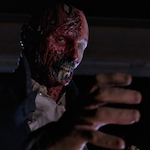
 After his horror breakthrough, his failed comedy, and his knockout horror sequel, Sam Raimi finally made it to the semi-big-time. He’d really wanted to do a movie of Batman or The Shadow, but could never get the rights. Then he came up with the idea for his own dark avenger, one with the ability to change his face. His 40-page treatment The Darkman was greenlit by Universal Studios in 1987.
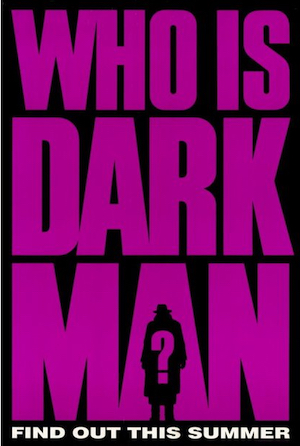 Raimi brought in NAVY SEALS writer Chuck Pfarrer to flesh out the treatment as a screenplay, which was then rewritten by Raimi and his brother Ivan (under the theory that Ivan, a doctor, could help make the medical sci-fi aspects plausible). The studio brought in the team of Daniel and Joshua Goldin (up-and-comers they also had working on PROBLEM CHILD) to bring the various drafts together before the Raimis went at it again. By the time the movie was made and released at the end of August, 1990, Tim Burton had made his BATMAN movie and all the studios were trying to mimic that success. Surely that was an influence on Raimi’s choice of composer Danny Elfman, and on the minimalist marketing campaign based around a silhouette and the question “Who is Darkman?”
I’m sure at the time I would’ve been interested in this movie anyway, but I was specifically excited when I read that it was the genius behind beloved video favorite EVIL DEAD II taking his first shot at a large scale mainstream movie. Seeing the posters, reading about it in magazines, seeing it on the big screen, I accepted it as a big time summer blockbuster alongside DICK TRACY, BACK TO THE FUTURE III and DIE HARD 2. But Raimi having four times his budget on EVIL DEAD II still meant about a third or a fourth of the budgets of those films. Even Cannon’s DELTA FORCE 2, released the same day as DARKMAN, had a slightly higher budget. I think it’s a testament to Raimi’s exciting directorial style that his many green screen and miniature techniques, which have dated technically more than any of those other movies, still seemed flashy enough to stand toe-to-toe with them. (read the rest of this shit…)
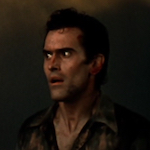 “Then let’s head down into that cellar and carve ourselves a witch.”
 THE EVIL DEAD was a hit. It took them a while, but they found a distributor, Irvin Shapiro. He’d been a founder of the Cannes Film Festival, and arranged for it to screen out of competition, where Stephen King saw it and loved it. Him raving about it in USA Today brought it outsized attention for such a small movie. It was well reviewed and became a sleeper hit, making 8 times its budget at the domestic box office (and then we all saw it on video).
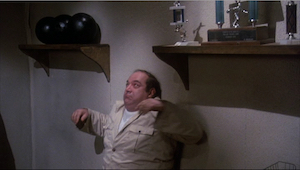 Raimi and Coen personality, from the precisely worded dialogue full of humorously archaic phrasing, to the over-the-top set pieces, to the straight up Three Stooges cartooniness. A favorite example of the latter: during a struggle, a shelf gets knocked down and a series of bowling balls (or cannonballs?) roll onto a villain’s head one after the other – don’t keep those on a shelf, people! That’s dangerous!
 Welcome friends, to a new review series. Each year on Halloween I like to post a piece on an all-time classic horror movie, usually one that I’ve been intimidated to tackle because so much has already been said about it that it’s hard to find a fresh angle. A couple Halloweens ago I decided to tackle Sam Raimi’s 1981 low budget classic THE EVIL DEAD. And I was really proud of the appreciation I put together, but writing it got me so excited about Raimi that I got a little ambitious. I decided I should do a separate one on the even better EVIL DEAD II. But watching that again got me thinking about other early Raimi movies, so I held off posting to grow it into a mini-series. And then I decided fuck it, I should do every movie he’s directed, even ones I’ve already reviewed.
 Twenty years ago when I was an enthusiastic but not that good internet movie reviewer I wrote a column called
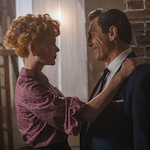 BEING THE RICARDOS is a straight-to-Amazon movie, the latest from playwright turned TV show creator turned screenwriter turned director Aaron Sorkin. It tells the story of one week in the lives of ‘50s sitcom icons Lucille Ball and Desi Arnaz, when a radio show had reported on Ball registering to vote as a communist in 1936, and they went ahead preparing an episode of I Love Lucy thinking their careers might be over.
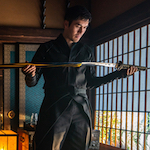 I had been pretty excited for SNAKE EYES: G.I. JOE ORIGINS, but I was skeptical about director Robert Schwentke (
 On January 1, 2013 I reviewed the movie
  “I’m sorry. How could I know this would happen?”
 Programming note: This will most likely be my last review until some time after Christmas. My MATRIX RESURRECTIONS review is in-progress but I don’t want to rush it and I’m hoping I can get in a second viewing soon. For now please enjoy this perhaps overly detailed assessment of a lesser known killer Santa movie. Happy holidays, friends!
 In 1972, like The King before him, Hess took his talents to the big screen, starring in a movie and recording the soundtrack for it. But this was pretty different from LOVE ME TENDER; it was Wes Craven’s LAST HOUSE ON THE LEFT, and he played the despicable villain Krug. It kicked off an acting career in American and Italian exploitation, episodes of Knight Rider, The A-Team, etc., often, I’m afraid, playing criminals and rapists. He was in THE HOUSE ON THE EDGE OF THE PARK, Craven’s SWAMP THING, and even Mark L. Lester’s John Candy movie ARMED AND DANGEROUS (as Gunman #4). Since he was reportedly a Method actor, I’m sure he was fun to be around.