"CATCH YOU FUCKERS AT A BAD TIME?"

A Time to Kill

July 24, 1996

A TIME TO KILL is a court room drama, but it was in the top ten of the domestic box office for 1996. It made more than some noisier movies like ERASER, THE HUNCHBACK OF NOTRE DAME, BROKEN ARROW, and EXECUTIVE DECISION. That used to be a thing that could happen. Of course, it was kind a name brand, because it came from the first book by John Grisham, and there had already been movies of THE FIRM (1993), THE PELICAN BRIEF (1993) and THE CLIENT (1994). And this one came from the same director and writer as THE CLIENT, Joel Schumacher and Akiva Goldsman. (They sandwiched this between BATMAN FOREVER and BATMAN & ROBIN.)
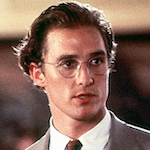
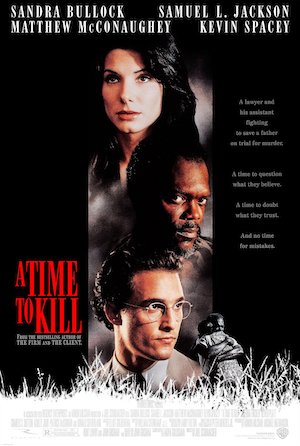
I remember all the hype about Schumacher choosing the virtually unknown Matthew McConaughey for the lead role of Mississippi attorney Jake Brigance. The actor had made an impression in DAZED AND CONFUSED, and had recently been in LONE STAR, but most people had never heard of him, and this was his first lead role. Schumacher was talking him up as the next big thing, and it worked! Soon after this he did CONTACT and AMISTAD. Watching it now it doesn’t seem like that flashy of a role, it just seems like McConaughey, but I guess it was more exciting when it was new. He definitely stands out in the movie by being Texan and not doing an outrageous southern accent like Kevin Spacey and Donald Sutherland do.
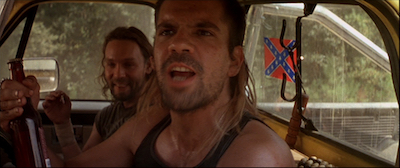
Back when “is the Confederate flag for racist shitheads?” was not considered a debatable topic

The movie starts with a horrific crime. Two racist redneck yahoos named Billy Ray Cobb (Nicky Katt, AMERICAN YAKUZA) and Pete Willard (Doug Hutchison, THE LAWNMOWER MAN) are driving around in a Confederate-flag-stickered pickup trick being white southerners in a manner that Joe Dirt would find a little too stereotypical. They’re throwing beer bottles, yee-hawing and being racist when they come across a ten-year-old Black girl named Tonya (Rae’Ven Larrymore Kelly, WHAT’S LOVE GOT TO DO WITH IT) on her way home from the grocery store. They (fortunately mostly off screen) rape and beat her and later when her father Carl Lee Hailey (Samuel L. Jackson, FRESH) embraces her barely alive body she whimpers that she’s sorry she dropped the groceries. Heartbreaking.

Everybody knows who did it. Sheriff Ozzie Walls (Charles S. Dutton, ALIEN 3) goes right to the bar where they drink and arrests them. When Jake hears from Deputy Sheriff Looney (Chris Cooper, LONE STAR) that they were arrested for rape he asks, “Who’d they rape?” and seems not to expect the answer to be upsetting. I don’t think it’s intentional but it’s establishing the movie’s world where how upset people get about a brutal attack depends on who the victim is.

Jake knows Carl Lee because he represented his brother once. Carl Lee shows up at his office, implies he’s gonna, you know… do something, and might need legal help. Jake’s wife Carla (Ashley Judd, HEAT) tells him he should tell the police, but he doesn’t. He kinda thinks he won’t do it, kinda thinks he should do it.
Sure enough, Carl Lee shows up at the courthouse when the rapists are being transferred, shoots them both dead, also accidentally hits Deputy Looney in the leg, and it has to be amputated. He feels bad about that part. I like the scene where Sheriff Walls comes to his house to arrest him, he says goodbye to his family and comes peacefully, doesn’t pretend to have to be told what it’s about, doesn’t have to be talked into it, nobody has to say anything.

So the movie is about Jake being Carl Lee’s defense lawyer, trying to get him off an on insanity plea. It’s an uphill battle not just because Carl Lee is guilty and did it in front of almost every character in the movie, but because he’s being prosecuted by D.A. Rufus Buckley (Kevin Spacey in his followup to SEVEN) and the judge is the aptly named Omar Noose (Patrick McGoohan, THE PHANTOM), who denies a request to change venue, so they end up with an all white jury. I don’t get this part but Buckley believes the case is a godsend that will guarantee he’s elected governor. I know it’s supposed to be a racism thing but I just don’t buy that putting away the guy that killed the vicious child rapist scumbags would guarantee him votes.
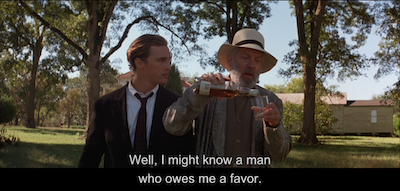
Schumacher uses the cinematic language to subtly, almost subconsciously imply that Sutherland’s character is an alcoholic

Jake could use some help, but he doesn’t accept it from Ellen Roark (Sandra Bullock, THE NET), a brilliant law student who shows up and hands him documents that save his ass in court and has all kinds of relevant experience and wants to work for him for free. Instead he tries to get his mentor Lucien Wilbanks (Donald Sutherland, BACKDRAFT), a once great civil rights crusader turned alcoholic disaster who was disbarred and says he will never set foot in a court room again, and his buddy Harry (Oliver Platt, DIGGSTOWN), a sleazy divorce lawyer. What the fuck, Jake, you fucking idiot. But obviously he eventually lets Ellen help and they get real close and it’s a good team.

Meanwhile, the late Billy Ray Cobb’s equally racist brother Freddie Lee (Kiefer Sutherland, THE COWBOY WAY) gets all the boys to come join the Ku Klux Klan with him and they start terrorizing Jake, his family, his secretary (Brenda Fricker, HOME ALONE 2) and her husband (Danny Nelson, FREEDOM ROAD). Kurtwood Smith (BROKEN ARROW) shows up a bit as a Grand Dragon named Stump Sisson, and M. Emmet Walsh (RED SCORPION) as an expert witness. And man, I thought that was her and sure enough Octavia Spencer appears briefly as a nurse, like she did in Rob Zombie’s HALLOWEEN II thirteen years later. This was her first movie.

One thing that’s distinctive about this movie is that Schumacher seems to be going for a world record of sweatiness. (I bet he noticed KAZAAM’s sweatiness too.) Nobody ever complains that it’s hot, but everybody has sweat on their brow, their cheeks, their collarbone, often soaking through the front and armpits of their shirts. Obviously outside is sweaty, and jail is sweatier than outside, but also the diner, the law office, the court room, the hospital, Jake’s house. I think the D.A.’s office has the only cool air in the region. I haven’t been to Mississippi before but in my very limited experience in the south I got the impression those people really had air conditioning figured out. According to this movie the electric fan hasn’t even made it down there yet. (Though there are hand fans in the Black church.)

Along with the sweatiness there is some sexiness, but no sex. I think the thread about the sexual tension between Jake and Ellen and him being able to walk away and stay loyal to his wife is effective, but it becomes comical when you learn that Grisham says the character is “basically me.” That’s probly why he vetoed Schumacher’s first choice of Woody Harrelson but was okay with the hot young new guy to play the great man who a brilliant, hot young student wants to fuck so bad but he’s too noble to let her. Congratulations, sir. No wonder you got a book and a movie.

(By the way, it seems like Ellen is supposed to be younger, being a law student while Jake has been working long enough to have his own practice, but Bullock is actually six years older than McConaughey. I think this a situation like Catherine Keener seeming to be in her twenties in WALKING AND TALKING – they were all new enough to the average viewer that they could fudge what age they were playing.)

Grisham said he conceived the book after hearing horrific testimony from a 12-year-old girl and wishing he had a gun to shoot the defendant. He spent three years writing it while he was a state legislator. It’s one of those origin stories everybody loves where it was supposedly rejected by 28 publishers before someone took it. (But it wasn’t a big hit until after The Firm.) Considering that he had been a lawyer and then was a politician when he wrote the book, it’s extremely cynical about the system. Carl is (understandably) so sure it will fail him that he doesn’t even wait for the trial to find out, he just kills the perpetrators. And then the righteous crusade to get him off requires an insanity plea that Carl says upfront is not true. “No matter what gets said in court, I knew what I was doing.” So kind of the premise is he has to convince the jury to do the “right” thing by doing the wrong thing.

There are a couple scenes where the jury decide to improperly discuss the case at dinner before deliberations. I think this is a smart storytelling choice because

1) it really shows that nothing in this case is going by the book

2) it shows us that the jury foreman (Terry Loughlin, ROAD-KILL U.S.A.) is totally comfortable calling the defendant the n-word and we don’t see anyone call him on it or seem bothered

3) and of course narratively it really shows the uphill battle being fought because we see that the jurors unanimously plan to convict Carl Lee.

So he has to change it in his summation speech, the one part of the movie almost as famous as Carl Lee yelling “Yes they deserve to die and I hope they burn in Hell!,” which I always think of in conjunction with “Give me back my son!,” “Get off my plane!” and “Show me the money!” But the people who said this was good (and there were many of them) didn’t cite the catch phrase, they cited the speech.

But I remember thinking this movie, and that speech in particular, were garbage. It’s obviously well produced and acted, it’s effective storytelling, but it grossed me out. Watching it 30 years later I really wondered if I’d been overreacting. I remembered one of the things I hated about it was that some hailed it as an important message about racism (as it is clearly intended), but it made its villains outrageously, outdatedly racist. Literally in the Ku Klux Klan, and protesting outside their courthouse in their robes. I felt it was a way to avoid talking about the actual racism people were dealing with in 1996 by portraying something out of a period piece, something that only existed on the very fringes that very few people would experience anymore. But of course, sadly, with the motherfuckers we’re dealing with in 2026 it seems tame.

On the other hand, I’d forgotten that it also portrays the NAACP as kinda sleazy opportunists who come into town and bribe the local reverend in their attempt to remove the heroic white lawyer (the real victim, really) from the case. The white man who gets crosses burned on his lawn, loses his home to a firebombing, the whole thing. When there are clashes between the actual hood-wearing white supremacists and the NAACP supporters on the streets I dearly hope I’m imagining it but it feels like we’re supposed to think well, both sides are really out of hand here. They’re all heated and a Black woman starts the violence by slapping a Klansman. We’re definitely not supposed to cheer for the kid who pops up on a roof with a molotov cocktail and sets the Grand Dragon on fire – save that for if the kid goes on trial and is found not guilty by reason of insanity due to the courageous trickery of a white lawyer. But I admit I did cheer. Death of the author.

(By the way, this somehow won NAACP Image Awards for Best Supporting Actor in a Film and Outstanding Motion Picture! For the latter it beat out COURAGE UNDER FIRE, GET ON THE BUS, ONCE UPON A TIME… WHEN WE WERE COLORED and THE PREACHER’S WIFE.)

Anyway I remember some of my co-workers at the time saying how moved they were by the summation speech, how it made them cry. Jake has the jurors close their eyes and then he emotionally and graphically describes the rape and beating of the little girl. (Earlier in the trial he wasn’t allowed to talk about that and now there’s not even an objection. The D.A. just gives up.) As I got closer to the conclusion I thought you know what, I must be remembering it wrong, it’s not really that bad. At the end he’ll say “Now imagine it’s your daughter,” because he’s just trying to make them understand the rage that Carl felt and that they would feel it too. This is what he and others have been saying throughout, that they understand him because they would’ve done the same. Now he’s getting the jurors to agree.

But that’s not what he says at the end. He says, “Now imagine she’s white.” They were upset, they were crying, but they were picturing the Black girl it happened to. When they picture her as white, that’s the kicker. That’s what switches their votes to not guilty. Oh shit, now that you put it that way, that was a really bad crime! And the thing is, it doesn’t come across as he recognizes the jurors are racist and he’s gonna pander to that to try to get these fucking numbnuts on his side. No, it seems like this is supposed to be a powerful argument that would sway anyone, that it will sway us as we watch the movie. That’s what my co-workers took it as! I couldn’t believe it. I guess it’s fair though for Joel Schumacher, the director of FALLING DOWN, to assume his audience is a bunch of racists. And he has to pull out the big guns to make them root for an anti-racist vigilante this time.

Yeah, that’s not so great either, the way it commandeers the tropes of sixties civil rights battles to make this seem like a righteous legal victory, when the law allows a revenge killing against the bad guys. The real case that inspired Grisham did not have the same racial dynamic; by adding it he can emulate To Kill a Mockingbird, but also add cover to his violent urges. To be fair, the real happy ending is the epilogue where Jake and Carl Lee’s daughters play together (and shake hands, my wife wanted me to mention, she thought that was ridiculous). So there is some optimism there. Maybe some day when they grow up they will, like, try to fix the legal system and people’s hearts and stuff instead of just kill the worst people.

I don’t like this movie.


This entry was posted on Monday, August 17th, 2026 at 8:29 am and is filed under Reviews, Drama. You can follow any responses to this entry through the RSS 2.0 feed. You can skip to the end and leave a response. Pinging is currently not allowed.

30 Responses to “A Time to Kill”

  1. I really disliked this when I saw it as a teen but couldn’t remember why. Reading your review brought it all back. After sitting through two plus hours of corny manipulation that “Now imagine she’s white” line was the kicker. The movie is straight up assuming its audience is racist and is trying to appeal to them on that level.

  2. As someone who is not a fan of courtroom dramas outside of 12 ANGRY MEN and the quirky David E Kelley shows of the 90s and early 00s, I haven’t seen this. Reading this review makes me think “Yeah, I can see how this could count as touching, daring, even progressive back then” and how critics of any skin colour would praise “Now imagine she’s white” as some kind of smart “Gotcha!” that makes audiences realize how ingrained racism is even among people who don’t think of themself as racist, like that riddle where a kid and her father have an accident and you have to correctly guess that the doctor at the ER is the mother.

    But sheesh, man…

    I think I have mentioned before how fascinated I am by movies and TV shows that were seen as super progressive on release, but are now more emberassing, unintentionally funny or exactly the kind of thing that they were trying to be against. This movie definitely sounds like one of the less amusing examples.

  3. I was 12 when this came out, and my parents brought me to see it in the theater. My dad was black and my mom is white. My dad grew up in the South in the 30s and 40’s, so he saw some REAL ASS RACIST shit and the sorts of horrifying things you would only expect to have happened 200 years ago, not, like, when my literal dad was running around, playing with his school friends.

    I remember all of us walking out of the movie and saying basically that we thought it had its heart in the right place but it was just too clumsy and dumb to really cohere into anything. I remember wondering what the point of “Now imagine that she’s white,” even was! I didn’t even understand that that was supposed to, like, sway me.

  4. I must admit when I was a projectionist in 1996 my involved college freshman/sophomore self was moved by the summation speech. I thought “oh wow, people really do have prejudicial assumptions.” How quaint a time. When you know better you do better.

    Which makes it worth asking, what are the actual GOOD Grishams? Rainmaker is all I’ve got. The right villain: a corrupt insurance company, and real underdogs. The Firm is fun. People like The Client but once he hires the lawyer I don’t remember a thing that happen. The Pelican Brief is essentially MacGuffin: The Movie (and I assume MacGuffin: The Book). I do kind of miss when there were authors who sold every manuscript to Hollywood as a brand name.

  5. This movie really is “WHITE SAVIOR: LAWYER”

    Nicky Katt, man, whatever happened there? Feels like so many movies with an ensemble cast, you have Katt in there stealing at least one scene, and he’s also solid in bigger roles he got like WAY OF THE GUN, but he was just stuck in bit parts, from this movie all the way to THE DARK KNIGHT. Seems a bit like Michael Biehn with the smaller successes and near misses that just never turned into higher profile roles. Always enjoy seeing him pop up though, RIP.

  6. grimgrinningchris

    August 17th, 2026 at 12:43 pm

    CJ

    See also: CHASING AMY

  7. I don’t think I’ve seen this movie (I did read the book, but so long ago that I barely remember it) so maybe it plays different than it sounds on paper, but I honestly think it sounds like a better choice to assume that everybody in the audience has some level of conscious or unconscious racial bias and to weaponize that against them than to do some BLIND SIDE shit and congratulate the totally-not-racist-at-all, “We’d have voted for Obama a third time if we could” white liberals in the audience about how not-racist they are compared to all those OTHER racist people who are totally NOT them. You might think you’re totally not racist because you’re not one of the assholes in the white hoods, but if you felt something in you shift when you switched the girl’s race in your mind, then don’t be congratulating yourself yet, because you still got some work to do. I can see the NAACP appreciating that message. And if it moved some people the way it was supposed to, then the movie was correct in knowing how to speak to those people. If you’re already doing that work, then the movie’s not speaking to you. But it sounds like it hit the right chord with its intended audience. And I don’t see how that’s a bad thing.

  8. Chris: I think CHASING AMY might actually be swinging back to progressive again, because it’s now being mentioned as one of the first movies to tackle the topic of bi erasure.

  9. Earlier in the trial he wasn’t allowed to talk about that and now there’s not even an objection

    You can’t object. During testimony he wasn’t allowed to talk about it. During opening/closing arguments the lawyer can say whatever the fuck they want.

    (sorry, dumb law thing)

  10. Haven’t seen this movie since the 90s.

    I remember it being the sweatiest movie of all time maybe?

    The widescreen cinematography looked amazing in theaters. Watching on HBO cut off half the picture.

    It felt like every actor in this movie is playing a caricature of some sort. It’s way over the top.

    But McConaughey stood out. He was an instant star and ironically the least known actor at the time in the main cast.

    Would a summer courtroom blockbuster be a hit today?

  11. I overall really liked this movie when I saw it at 17 (having already read the book), but that final speech also rubbed me the wrong way. I can definitely see what it’s going for, and how it could hit some people hard, but to me it felt like lazily simplifying the issues at hand.

    Which was my issue with a number of choices in the movie; making Spacey’s DA so blatantly corrupt and racist and evil (and with Spacey at his sleaziest and most scenery-chewing) in particular bugged me. The DA in the book isn’t likeable, but he’s just an ambitious blowhard. Honestly, though, I think it would have worked better with an approach like A Few Good Men, where Kevin Bacon’s prosecutor is a good man doing his job and who really believes he’s on the right side.

    And that frustrated me, because I found much of the movie to be a really compelling melodrama! Samuel L Jackson gives one of his finest performances, and his “I hope they burn in hell” speech is deservedly iconic. McConaughey is perfect as the heroic lawyer, and whatever my issues with that final summation, I found his performance of the speech quite powerful. The cinematography is spectacular. There are a lot of beautifully-crafted scenes. I thought it was good and get why it was a hit! I was just frustrated that it wasn’t better.

    I will say, having spent a lot of time in the South (lived in Austin for years, have a lot of relatives in and around New Orleans), on a hot summer, it doesn’t matter if they have A/C, you cannot get away from the heat and humidity. It doesn’t help that often the A/C is just one or two of those window thingies that never really work well in a house so much older than A/C and built when the climate was cooler. I don’t know if everyone sweats as much in a hot summer in the South as in this movie, but I sure do.

  12. years ago a news item involving someone in an abusive relationship came up as a topic of discussion in my friend group and one of the engineer types – this is the one who went on to work at amazon’s streaming video network operations – asked why the person experiencing the abuse didn’t leave, and i had to explain to him that it was likely out of a fear of reprisal and continued harassment. later when jeff bezos made all of his office-bound employees sit through annual diversity training videos this same guy made a point of telling us it was a waste of time, and that he ignored all of it in favor of making a monetary donation to some random black rights charity. there’s no accounting for whatever deeply stupid blind spots people may have.

    i’ve never seen this movie and had no idea patrick mcgoohan was in it; coincidentally his only directing credit, which i had never heard of and is an adaptation of a stage musical version of othello by way of jesus christ superstar in which othello is now a preacher leading a southwest desert commune, just popped up on the tracker so i’m going to check that out tonight. kismet

  13. Crudnasty: Nicky Katt was a principle'(no pun intended)cast member on the Fox television drama BOSTON PUBLIC, but I think he had substance abuse problems that kept him from being a bigger name. I do agree that he should have gone on to do more. Shame.

    Tim: I think the waning of interest in the courtroom movie reflects a steady erosion of the public’s trust in the American justice system. It’s just too difficult to suspend disbelief when you have a convicted criminal sitting in the highest office of the nation.

  14. I’ve always been pro-CHASING AMY, because I never understood the criticism that it was about “fucking a Lesbian straight”. If someone is into men and women, the person is obviously bi-sexual, even if Americans didn’t seem to know what that is until the late 00s and therefore the term won’t get mentioned in the movie. In the end it’s a movie about loving who the heart wants to love and accepting your loved one with all their flaws, BUT only if they are worth it. There is somewhere in another universe a more Hollywood-ized version (Ending spoiler) where Affleck is forgiven for being such an asshole with no questions asked and they live happily ever after, instead of the more acceptable actual ending where they break up and realize that they are better off being friends.

    Plus: The movie also offers an even today rarely seen portrayal of male friendship. It’s strange, but between Dante and Randall from CLERKS and Holden and Banky from CHASING AMY, Smith is even today one of the few filmmakers who is able to portray a deep friendship between men in a realistic way, without any “Bro” hypermasculinity or “LOL, they secretly wanna fuck because there is no other explanation that two men care about each other” bullshit.

    In the end I do think that the later backlash against CHASING AMY came from Smith’s tendency for gay jokes and slurs in his other works until (and especially in) JAY & SILENT BOB STRIKE BACK. It is kinda hard to take someone’s pro-gay movie seriously if in all their other work (at that time) characters call others gay slurs. And while you can criticize him for that, you also can’t fully blame him, because during that time homophobia was sadly a socially accepted comedic style and even popular lame sitcoms like FRIENDS leaned heavily into that.

    (Sadly I didn’t have a chance to watch CHASING CHASING AMY, the documentary that defends the movie from a queer POV yet.)

  15. a realistic way, or one we’re more attuned to because the characters also constantly talk about comic books and star wars? i know i’m an outlier and this is a wild generalization representative of the milieus i’ve surrounded myself in but in my experience most straight american adult males are essentially nonverbal when asked to engage with interpersonal matters. and they do now say “bro” like it’s a tic or they’re getting paid for it

  16. I haven’t read the book, so I don’t know if it’s in there or it’s all up to Schumacher, but this movie has stolen everything from Otto Preminger’s ANATOMY OF A MURDER. Except maybe the fact that James Stewart doesn’t wear singlets and seem unable to break a sweat. Preminger’s movie was one of the first really controversial court room dramas, and one of the masterpieces within the genre. This isn’t. The first time me and my way better half watched A TIME TO KILL we didn’t think much about it afterwards. But the second time we had to turn it off. It just creeped us out, in several ways.
  17. so-and-so

    No, more realistic because these characters DO care for each other, wanna spend time with each other, become annoyed and even anxious when their best friend’s life drifts into another direction because they are scared of never finding another friend like him and while not constantly saying “I love you, man”, are not afraid of doing so in the right moment. And all that without the movie ridiculing them, by making them look like a stereotypical gay couple for laughs or adding that stupid “Bro” bullshit into the mix to assure to the audience that yes, these are manly men, no homo! Seriously, these characters are way more normal and well adjusted, like the men that I know, than most male characters in our popculture. Shit, even Good Dad Jay from JAY & SILENT BOB REBOOT fits into that category.

    And yes, also because they talk a lot about nerd shit.

  18. right, but i don’t believe any of those things are mutually exclusive or any more or less ‘real’ than one another. my point is that smith is speaking from a narrow world view to a narrow audience. this a movie that also gave us the character of hooper x, which, cripes. and on that note, back to discussing film portrayals of american racial injustice?

  19. I could never stand A Time To Kill. Its just an obvious, rigged court-room drama that yells like an over-confident teenager and should bow its head to real court-room films like Anatomy Of A Murder.

  20. In one of his “An Evening with Kevin Smith” college lecture tour videos, Smith faced criticism from a lesbian student who objected to CHASING AMY seeming to say that lesbians “just need a good d*cking” from a man.

    That might have been my first time seeing something that has supposedly become commonplace in online culture today – the idea that if a character does or says something then that means the author agrees with it, ignoring any clues that the character (in this case the obnoxious best friend of the protagonist) is meant to be wrong or that the story proves him wrong.

    I enjoyed the CHASING CHASING AMY documentary.

  21. The “imagine she’s white” kicker isn’t intended to weed out racists among the viewers. The wording makes total sense in the context of the movie, and it was a great choice.

    It’s directed at the jurors, who have just been through an intense trial about the rape of a little Black girl. So, when Jake asks them to close their eyes and imagine the scenario, they have been picturing a Black girl. Because that’s what the trial is about (well, it’s about a dad killing his Black daughter’s rapists, but you know what I mean).

    So, as he’s been leading them along to re-enact those horrible events in their minds, he knows they will have been picturing a little Black girl. Because Carl Lee Hailey’s daughter was Black. They didnt choose that colour because that’s how they see all pre-teen rape victims, but because that was the colour of this particular person.

    Jake could have come out and said, “Come on guys, you’re treating this poor girl as if she’s just an insignificant ‘Other’, nothing to do with you, not deserving of your empathy. But what if she was your daughter?” But instead he makes them put themselves in her shoes, most likely still keeping their “she’s just an Other’ defenses up (although if I recall, there are a few tears among the jurors – been a while since I’ve seen it), and this concept of “us and them” among this community has been firmly set up throughout the preceding 2 hours, however ham-fistedly we may have found the methodology.

    So when Jake delivers the “white” line, he’s already been priming them to open up emotionally, and so his point really lands with them. They have to revise the horribleness they just imagined and actually put themselves into it.

    Yes, he’s exposing the racism of the jurors. But I simply don’t agree that the line is supposed to be making us ourselves confront our racism and prejudice of the Other.

    Conversely, I think that if the line had been “imagine she’s your daughter”, like Vern suggests, it wouldn’t have landed. Because that’s too on the nose — the sign of the writer signposting A Message that they want to make sure no one in the audience will miss. I feel that the fact that they didn’t go that way is actually keeping the scene firmly in the context of the movie, not trying to preach to or patronize us.

    Thoughts?

  22. Wait, I could use some clarity on the “you can say anything you want in opening and closing arguments” thing. So if it’s a drunk driving case and the defendant’s past drunk driving incidents have been ruled inadmissible, like no one can even allude to them during trial, because it would prejudice the jury against the defendant…you can bring them up in closing arguments?

  23. No, Acid Burn, you are correct, “you can say anything” drastically oversimplifies it. You’re actually very limited during the opening statement and can’t say anything that could, uh, arguably be considered making an argument. You’re only (theoretically) allowed to set forth the evidence you intend to present. It’s true that there is a lot more leeway allowed during close argument, but it still needs to be based on the evidence that was presented during the proofs of the case.

    And the example you cite, making a closing argument about inadmissible stuff, is a perfect one. You’d be in a world of shit with the judge, and you’d be begging for a mistrial, if you did that. Granted, you might be aiming for a mistrial …. but not likely at your own financial and reputational expense, not to mention potential sanctions on your law license, or even a little jail time for defying the judge.

    Having said all of that, I’m just setting forth purely textbook stuff here, and I’m sure all kinds of crazy shit could waltz right past the judge and opposing counsel during all of the many openings and closings that go on every day all over the country. But honestly I’ve never seen anyone get away with that kind of dramatic nonsense. Judges tend to be sharper than they are often given credit for, and they tend to shut that stuff down pretty quickly.

  24. Thanks, Johnny Utah, you beat me to it. It is absolutely not true that “During opening/closing arguments the lawyer can say whatever the fuck they want.”

    In my state a sex abuse conviction was just tossed out because during closing arguments the prosecutor asked jurors to “think of their loved ones” when considering the evidence, which is not the charge of the jury.

    I’m not even a trial attorney, but I notice stuff in movies/TV all the time and think “no one is going to object?”

  25. Thank you, Utah and Time. It sounded like a pretty absurd claim to me, so I appreciate confirmation that the U.S. court system does not have a strict set of rules for the whole proceeding until a final “no holds barred” round.

  26. Acid burn, haha, yes. “Your honor, now that it is closing arguments, permission to spout wild nonsense to the jury?”

    “Yes, but watch yourself counselor”

  27. I think “Now imagine she’s white” doesn’t work for a different reason: The jury would be able to pick up on the clear inference and they’d think “Hey, fuck you, man, I’m not racist, I’d treat this the same no matter what color skin the victim has!”

    It’s that thing where racists (or bigots of any kind) will twist themselves into knots saying the real racists are the people who call people racist. Very few bigots are “wear klan robes outside a courthouse” proudly confident in their idiocy and most of them dig their heels in and turn into a sputtering Yosemite Sam mess when called on their shit.

  28. Yeah, for brevity’s sake I was just talking about the movie/situation at hand, but I guess it was a gross oversimplification. So in the hypothetical movie where Matthew McConaughey suddenly told the jury that the hillbillies were carrying the plague and Sam Jackson was merely acting to contain the deadly disease, opposing counsel could mount an objection, and it would probably be sustained.

    Now, could opposing counsel have mounted an improper passion/prejudice objection? There’s certainly an argument that perhaps he should have. Maybe the better, hypothetical movie would have let McConaughey get to his punchline then have opposing counsel object after the jury had already heard it and deeply moved to an acquittal (see: The Verdict. A better movie)

    Anyway, in the shitty movie we’re talking about, defense counsel was already granted the leeway in opening remarks, so there really wasn’t anything the prosecution could object to. While we’re being prescriptive, I did state that prosecution couldn’t object, which was obviously untrue, as he wasn’t gagged or disabled in any manner.

    Initially, I was attempting to type very little about a movie I didn’t like and barely remember, now I’ve typed a whole bunch. Fucking lawyers, man… You have to watch every word around those creeps.

  29. “The real case that inspired Grisham did not have the same racial dynamic; by adding it he can emulate To Kill a Mockingbird, but also add cover to his violent urges.”

    I haven’t seen this since it came out, and I’m not going to rewatch it in order reassure myself about my memory of it, so I’ll just secondsay this sentence, which I think perfectly encapsulates how deeply bad, dumb, and dishonest this movie is.

  30. grimgrinningchris

    August 23rd, 2026 at 4:43 pm

    Jojo What if you’re not into the whole brevity thing?

Leave a Reply


XHTML: You can use: <a href="" title=""> <abbr title=""> <acronym title=""> <b> <blockquote cite=""> <cite> <code> <del datetime=""> <em> <i> <q cite=""> <s> <strike> <strong>