
 June 21, 1996
LONE STAR is the summer of ’96 joint from John Sayles, a limited release but made $13 million on a budget much lower than that, and well reviewed. Roger Ebert called it “a great American movie, one of the few to seriously try to regard with open eyes the way we live now… the best work yet by one of our most original and independent filmmakers.”
 I must confess that to this day I’m not acquainted enough with Sayles’ work; I respect that he wrote PIRANHA, BATTLE BEYOND THE STARS, ALLIGATOR, THE HOWLING, etc., but his earliest directorial work I’ve seen is still THE BROTHER FROM ANOTHER PLANET (which I love), so I don’t have a full picture of these dramas that are his main thing. In the ‘90s, though, I was at an open minded age and trying to see the Important New Works, so I saw both THE SECRET OF ROAN INISH and LONE STAR when they played indie theaters. I barely remember them, other than that I thought they were good, so I guess they weren’t the specific type of good that made a strong impression on me in those days. (They weren’t THE PHANTOM.)
Many still consider LONE STAR one of Sayles’ best, it’s in the Criterion Collection, and I was excited to revisit it as a more wisened, soon to be wizened being. Yeah, it’s a good movie, and I think I was probly much more interested in analyzing its themes than I was before. But I have to admit that it still gives me more of an academic “that was good, that was interesting” feeling than a heartfelt “god damn, I’m gonna watch that again.” Maybe if some of you love it you can talk me up on it.
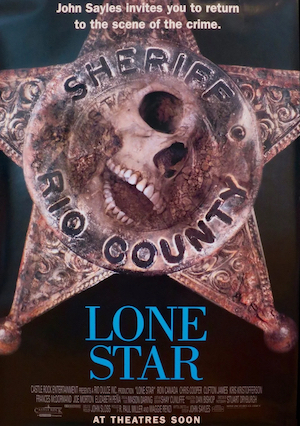 I remembered it involved a murder mystery, a corrupt sheriff, I pictured it being kinda dark, maybe because of that original movie poster. So I was surprised when the opening was dryly quirky. Yes, it involves the literal uncovering of a small town’s old skeletons, because two locals find a skull half buried in the desert. But it’s two off-duty, bickering army sergeants dressed like they’re at a barbecue. I love these guys. Mikey (Stephen J. Lang, later in DISTURBING BEHAVIOR) uses a metal detector to find old bullet shells for the sculptures he makes, and Cliff (Stephen Mendillo, CHRISTMAS EVIL) catalogs the plant life, lecturing Mikey for not caring about what he calls the “cactus and shit.“
“Not just cactus. There’s the acacias, the yuccas—“
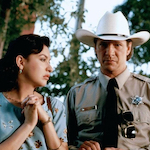
Cliff finds the skull next to a Freemason ring and a rusty sheriff’s badge, so everybody knows it was the notoriously corrupt asshole Charlie Wade (Kris Kristofferson two years before BLADE), who disappeared with $10,000 of the county’s money in 1957. He’d had a confrontation with Buddy Deeds (Matthew McConaughey, THE RETURN OF THE TEXAS CHAINSAW MASSACRE), who succeeded him as sheriff and decades later is regarded as the town of Frontera’s greatest hero. The current sheriff is Buddy’s more laid back, thoughtful son Sam (Chris Cooper, MONEY TRAIN), who worries that this case might lead to unpleasant revelations about his father. Interestingly it’s the town that’s protective of that myth. He’s less fond of it than they are. He became sheriff based on Buddy’s legacy but he’s still an outsider, having only returned to town two years ago.
At the station Sam runs into and does a favor for Pilar (Elizabeth Peña, BLUE STEEL), who he hasn’t talked to since high school. They were in love then, but Buddy and Pilar’s mother Mercedes (Míriam Colón, SCARFACE) wouldn’t let them be together. Mercedes, now a restaurant owner, still grumbles about “that boy.” But they’re old now and Sam is divorced and Pilar (a history teacher at the high school) is widowed, so…
As Sam goes around asking people for old stories to solve the mystery, we learn that Wade was a total piece of shit – or “one of your old-fashioned bribe-or-bullets kind of sheriffs,” as the then-deputy, now mayor Hollis Pogue (Clifton James, THE WEREWOLF OF WASHINGTON) puts it. We see Wade extorting and murdering various minorities, including Mercedes’ husband Eladio (Gilbert R. Cuellar Jr.) for bringing people across the border without paying him. But Sam also learns that his sainted father took part in less violent but similarly damaging forms of corruption.
The connections between the past and present are shown visually by transitioning between time periods not with a cut but a pan to a character from the past or future inhabiting the same spaces. Locations of long ago consequential events are still parts of everybody’s daily life.
There’s sort of a parallel story about Colonel Delmore Payne (Joe Morton, T2) returning to town to command the Army base. Not really a sign of progress, though, since it’s a base scheduled to be shut down soon. He doesn’t want to talk to his dad, beloved local bar owner Otis (Ron Canada, HONEY I BLEW UP THE KID, GETTING EVEN WITH DAD), but his son Chet (Eddie Robinson, Swans Crossing) – who by the way is one of Pilar’s students – sneaks out to try to meet his grandpa, and ends up witnessing a shooting, which is another investigation the movie follows. Also young Otis (Gabriel Casseus, GET ON THE BUS, BLACK DOG) is around Charlie and Buddy and Hollis in the flashbacks. For such a slow, contemplative movie it’s pretty damn complicated.
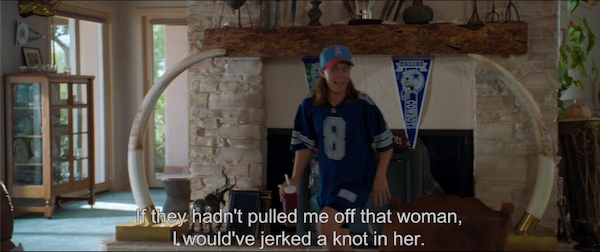
Frances McDormand (DARKMAN) shows up for one long showstopper of a scene as Sam’s ex-wife Bunny. She’s almost the Mike Yanagita of the movie. He stops by to see if she still has a box of his dad’s things in the garage, and they have a friendly check in. She loves to talk, rattles on about how her favorite teams are doing, is medicated for something that she quotes others as calling being “high strung” or “tightly wound.” She implies that’s the reason they didn’t work out, but you can see she had a different American dream than him, living outside of town with her giant house and TV and sports memorabilia.
LONE STAR got an Oscar nomination for best screenplay, losing honorably to McDormand’s own FARGO. Same thing happened at the Independent Spirit Awards, where William H. Macy took Best Male Lead over Cooper but Peña actually won because they put her in Best Supporting Female. Sorry, Queen Latifah in SET IT OFF. You would’ve deserved it too.
McConaughey broke out as a movie star a month later as the star of Joel Schumacher’s execrable John Grisham thriller A TIME TO KILL. Cooper was also in that, but I think this was the role that put him on the (more humble, indie-oriented) map. Peña stayed more under the radar, but she was in RUSH HOUR and THE INCREDIBLES. She died much too young in 2014.
 30 years after LONE STAR’s release it seems either Sayles was a prophet or nothing has changed, because here are some of the things going on in the movie: white people are freaking out that they’re no longer the majority in a town with strong Tejano, African American and Native American communities. They’re at school board meetings yelling about “tearing down our heritage,” trying to stop Pilar from “changing who did what to who” by teaching history. In the past, Buddy was involved in evicting and flooding a Mexican and Chicano community to make it a resort town and own lakefront property. Now they’re trying to build a for-profit prison because “the people are concerned about crime” even though the sheriff himself says it’s not needed. And when Mercedes is relaxing in her fancy-ass backyard and sees somebody who crossed the border illegally, she calls Border Patrol, even though (we later find out) she came here illegally herself. So many divisions between cultures, within cultures, so many people clinging to old fairy tales or cover ups, making new ones to serve their needs.
That all hits me intellectually. The part that hits me more emotionally is the romance between Sam and Pilar. The actors are so good, the characters so down to earth, and the idea of these regular middle aged people finding passion for each other again is hot in a way that more glossy Hollywood stories are not. Are they hanging onto something from the past, or are they revising their own history, fixing a wrong that was done to them? Doesn’t really matter. They’re finding something that makes them happy. It’s something I got invested in.
But then there’s the surprise ending where (BIG TIME SPOILER) Sam figures out, and gently breaks to Pilar, the real reason their parents didn’t want them together: Buddy had an affair with Mercedes, and they’re half-siblings. She’s sad about it but argues that the taboo against incest is about having babies, and she can’t do that, so it should be okay. They seem unsettled but willing to stay together. And we can make our judgments about that or not, but I guess I don’t know the reason for this curveball, why this is what we’re left to consider at the end. Maybe it’s symbolic, about how these separate communities are really one and the same? But I think that would be the figurative overwhelming the literal there. Maybe it’s because of CHINATOWN having an incest revelation? I guess that would accidentally be a good parallel to the school board meeting. It’s a movie that certain people are gonna want to talk about as a great artistic achievement and get mad when their kids want to talk about what the director did that one time.
But I really don’t know what to make of that ending. Maybe give it another 30 years.
‘90s shit:
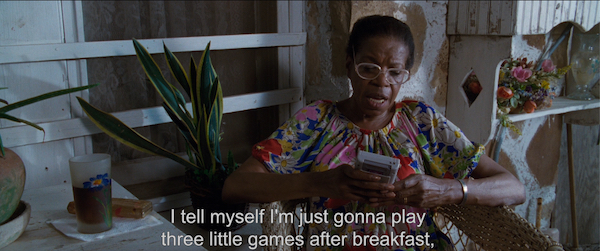
Since I noted Elijah Wood’s Gameboy use in FLIPPER I should also mention this funny scene where an old lady he interviews talks about being addicted to it. I really wish they had done a tie-in Gameboy game but I have found no evidence of that.



























July 2nd, 2026 at 12:46 pm
Spoilers in this comment but not in the sentences immediately following this one:
I think you’d like Matewan, the first Sayles/Cooper collaboration and the first movie Cooper was in period. Cooper is in a lot of stuff I couldn’t care less about, but he’s always great, and he might be at his best there (or Adaptation). Matewan gives me a true, sincere “Fuck yeah, this is the power of the human spirit” rush, which is sort of the opposite of the intellectual remove described here.
The incest revelation and subsequent Oldboy shoulder shrug is definitely repellant, and one of the reasons I don’t feel bad about not owning Lone Star. I’ve never seen anybody else say this, I may be wrong, but my take on the incest puts everything at even more of an intellectual remove. I think it’s there to continue the theme of digging up the past. You can look into all of these dead people, but you’re going to have to deal with what you learn. You can try to uncover the legendary white hat sheriff’s secrets, but maybe first consider what it would mean to find out Dad was in on some bad shit with the black hat sheriff. Cooper decides to let the case of the Kristofferskull go unsolved. He decides that maybe the town is better off not knowing McConaughey, their symbol, was on par with the guy he replaced.
Cooper finding out he’s related to Pena is like, good job, dude, you finally reconnected with this person against all odds, why do you feel the need to figure out why your parents kept you apart? You found something great and then couldn’t stop poking at it. Like the revelations about his father, Cooper takes the revelations about his other connection to Pena and decides “Maybe we just put this on a high shelf and try to forget about it.” Maybe we print the legend about Buddy.
The problem the movie leaves me with is whether Cooper and Pena are making the right decision. Politically, as a metaphor for everything I’ve just mentioned, I think Sayles would say no. He seems to have a very good sense of world history and for not accepting myths as they’re presented. I could listen to him talk all day. These people aren’t going to have an inbred baby because they aren’t going to have a baby at all, but they’re going to spend the rest of their lives dancing around this very gross elephant. You dig into the past, you find out stuff you don’t want to know, and then Sayles asks “What do you do with this stuff?”