 Paul W.S. Anderson stays in the director’s chair for the fifth one, RESIDENT EVIL: RETRIBUTION. This one starts at the end of the action scene that starts right where AFTERLIFE left off. Then it shows us that scene in reverse, then regular, and narrator Alice (Milla Jovovich, ULTRAVIOLET) tries to summarize the convoluted events of parts 1, 2, 3 and 4. And then they remake the remake of DAWN OF THE DEAD, showing Alice as a suburban mom just going about her business when the zombie outbreak explodes into her life.
That’s the fun of this series: the unpredictable patchwork of set pieces and gimmicks, often playing with expectations, making it seem like the story (like a video game?) is starting over and everything is different, but things usually turn out to have a pretty good explanation.
Okay, the explanation is always clones. Clones are the reason Michelle Rodriguez and Oded Fehr, whose characters died in previous chapters, are suddenly back as different people. Multiple different people. For a while it seems like Rodriguez came back to the series after a ten year absence just for a comically brief cameo where she gives Alice a ride and then crashes 30 seconds later. Then Alice is killed by a zombie. (read the rest of this shit…)
 RESIDENT EVIL: AFTERLIFE is part 4. Series writer-producer Paul W.S. Anderson returns as director for the first time since part 1. I really like how each chapter seems to be completely different from the previous ones, and this is no exception. The new style may be in part because Anderson hadn’t directed a RESIDENT EVIL in eight years (having only directed
  RESIDENT EVIL: EXTINCTION is part 3. It takes place five years after part 2, APOCALYPSE, and was released five years after the first film in the series. It has a different style and tone, a little more serious, a little more grounded, but still pulpy, and it really works.
 RESIDENT EVIL: APOCALPYSE is the second one. Part 1’s Paul W.S. Anderson scripted it, but handed directing duties over to Alexander Witt (the second unit director for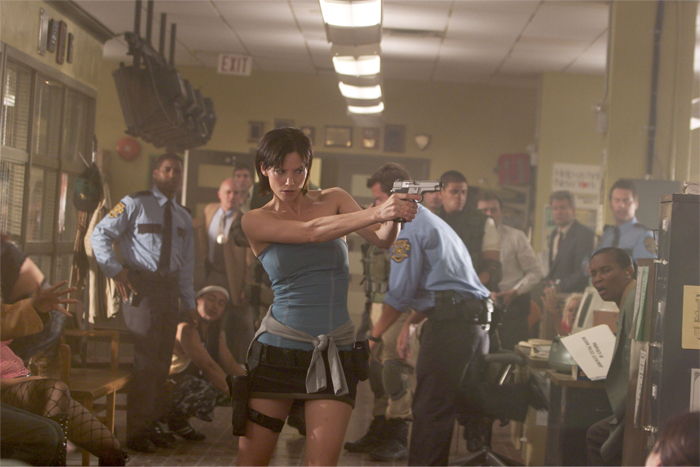
 The RESIDENT EVIL movie series is sort of a zombie in its own right – a dead thing leftover from another time, somehow still walking the earth. When the first one came out in 2002, movies based on video games were still a novel concept that had only really been done successfully by this same director, Paul Anderson, with
  It’s weird how long I’ve been anticipating xXx: RETURN OF XANDER CAGE. I didn’t actually like
  With the inauguration about to happen I think alot of us kinda feel like we’re all alone, torn open, bleeding and floating on a dead whale, unable to get to shore because a shark the size of a fuckin bus wants to eat us and will not leave us be. So I thought you know what, what if there was a movie about somebody else in that situation, maybe if it had a positive outcome it would be a good inspirational tool for all of us as citizens of the United States and the world who hope to somehow survive the coming shit show of dangerous ignorance and blatant, barely-even-trying-to-fuckin-hide-it-at-all corruption.
 Writer/director/actor/martial artist Jino Kang’s first film
  MONSTER TRUCKS is literally about monster trucks. This is a movie about an oil company drilling through a pocket of water deep beneath the earth, accidentally releasing a huge, squid-like creature who crawls into a junkyard and hides inside the chassis of a teen’s crappy pickup truck. Soon the teen discovers that the creature can wrap its tentacles around the axels and spin them, basically acting as its engine. Also it eats oil and it can not only drive and steer the truck but jump and bounce and climb up walls and shit.
 Well, I’m skipping ahead in the Spike Lee chronology I’ve been ever-so-slowly crawling my way through, but I thought a movie about a march on Washington would be a good thing to revisit on the Martin Luther King Day starting the week that, as far as we know, will end with the inauguration of the first American president to be 2 degrees of separation from Steven Seagal (they have a mutual friend, a Russian guy named Vladimir something) and subsequent protest march.