
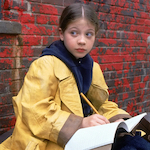
 “You’re an individual, and you know something? That makes people nervous. And it’s gonna keep makin’ people nervous your whole life.”
July 10, 1996
HARRIET THE SPY is a theatrical motion picture offering from Nickelodeon, television’s foremost purveyors of double dares and super-sloppiness. It does in fact include green slime splashing on the face of an outraged mother, plus its heroine being covered in blue paint. But what you may not guess about this movie is that it’s extremely artful. The slime is a brief instance, not a set piece, and the paint is striking imagery in a heartbreaking sequence when the titular Harriet M. Welsch (Michelle Trachtenberg, The Adventures of Pete & Pete) tries to hold her head high while the entire sixth grade turns against her. 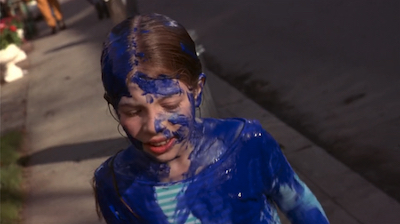
This is a really special movie that balances on overall feeling of quirkiness with an impressively naturalistic performance from the young lead. It paints a beautiful portrait of a city inhabited by different cultures and eccentrics and artists, while treating messy childhood emotions seriously. It’s about kids (and people in general) being curious about the world, following their passions, being their authentic selves, but trying not to mess up their friendships. I think it’s one of the great children’s movies of the era, though nobody else seemed to think so at the time.
 As in the beloved 1964 book by Louise Fitzhugh, Harriet is an eleven-year-old New York girl (filmed in Toronto) who wants to be a writer. Her beloved nanny Golly (Rosie O’Donnell, THE FLINTSTONES) has told her that means she has to observe the life around her and take notes, so she does.
Her witty journal descriptions of classmates make up the opening narration, introducing us especially to her best friends Janie (Vanessa Lee Chester, CB4) and Sport (Gregory Smith, LEAPIN’ LEPRECHAUNS), who are fellow haters of class snob/president Marion Hawthorne (Charlotte Sullivan, Christmas episode of Kung Fu: The Legend Continues). After school Harriet has her “spy route,” which involves lots of climbing and sneaking and peeping through windows to observe and write lovingly about the odd antics of the people in her neighborhood. These include the Hong Fat family, who own the Chinese market, and a jazz loving, too-many-cat-having birdcage maker named Harrison Withers (Don Francks, MY BLOODY VALENTINE, JOHNNY MNEMONIC, voice of Boba Fett on The Star Wars Holiday Special). They don’t even know she exists, but she’s invested in their lives and in telling us all about them.
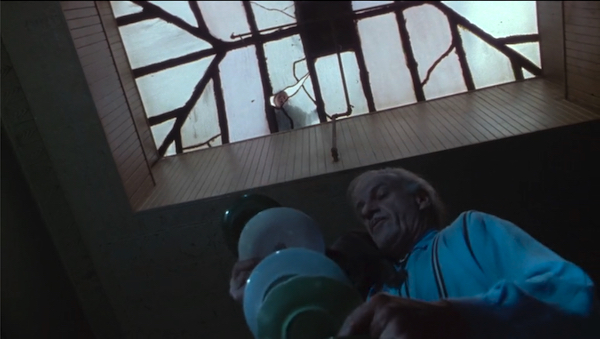
The Hong Fats have a bicycle deliveryman (Eugene Lipinski, “KGB Agent #1,” FIREFOX) who Harriet labels a “veggie thief” before he coincidentally shows up as Golly’s date and turns out to be cool. You can’t know everything just from watching people, it turns out. But she tries. Later she goes as far as breaking into a mansion and hiding in a dumbwaiter to spy on the wealthy eccentric shut-in Agatha K. Plummer (Eartha Kitt, BOOMERANG).
They’re no Agatha K. Plummers, but the Welsches are clearly pretty well off. I mean, they have a nanny. Mom (J. Smith-Cameron, JEFFREY) and dad (Robert Joy, DEATH WISH V: THE FACE OF DEATH) are okay but seem to spend more time at cocktail parties than with their daughter. Harriet probly prefers being with Golly, though, because “she sees things other people barely notice” and preaches that “there are as many ways to live as there are people in this world, and each one deserves a closer look.”
The beautiful thing is that HARRIET THE SPY really believes that. It’s a movie that loves people, casting actors like Kitt and Francks whose small parts convey long, interesting lives. It also loves artists, glorifying the nobility of the writer even though Harriet doesn’t initially understand Sport’s dad (Gerry Quigley, SABOTAGE) prioritizing his dream over financial security. Golly’s ways of sharing culture with Harriet range from bringing her to see MATA HARI (which she loves) to quoting poetry to bringing the kids to her friend Mrs. W (Mercedes Enriquez, THE SUBSTITUTE)’s garden of windchimes, hubcaps, bottles and ties to play and craft and toast their life’s goals with 7-Up. She teaches them to be themselves, and that’s what they do. They’re unusual for movie kids, especially girls. It wasn’t as revolutionary in 1996 as it was in 1964 to have Harriet and Janey obsessed with writing and science, respectively, but it wasn’t nothing.
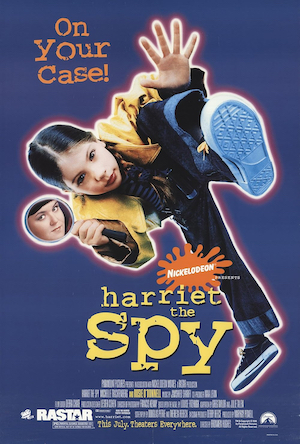 This was the very first production of Nickelodeon Movies (followed by GOOD BURGER and THE RUGRATS MOVIE) and one of the last from Rastar (which started with FUNNY GIRL in 1968). There are many associations we have with Nickelodeon. People my age remember it importing You Can’t Do That On Television and Count Duckula before the game show Double Dare made it all about dumbing slime on people’s heads. But (like MTV) Nickelodeon had a respect for weirdo artists. When they introduced their animated offerings Doug, Rugrats and The Ren & Stimpy Show in 1991 those were each the distinct vision of a new creator, with a different look and feel from anything else on TV, and they changed everything.
Not quite as well known, but more emblematic of the quirky artist side of the network was The Adventures of Pete & Pete, a series of goofy interstitials that expanded first into specials and then three seasons of an actual show. Trachtenberg played the best friend of one of the Petes. Toby Huss played their adult hero Artie, the Strongest Man in the World. Other characters were played by Steve Buscemi and Iggy Pop and guest stars included Debbie Harry, Juliana Hatfield, Patty Hearst, David Johansen, LL Cool J, Luscious Jackson, Ann Magnuson, Kate Pierson, Michael Stipe, Richard Edson, Chris Elliott and Martin Donovan. The band Polaris provided much of the music, plus needle drops of actual bands cool adults liked.
I always felt like HARRIET THE SPY came out of that Nickelodeon. The hip Nickelodeon. Unless her birthdate has been misreported, first time feature director Bronwen Hughes was still in her twenties. She’d directed commercials, a couple music videos and episodes of The Kids in the Hall. She was going for kind of a timeless feel, so the only alternative rock is the end credits theme “The Secretive Life” by Jill Sobule. But it’s an eclectic soundtrack that works in the classic “Wack Wack” by Young-Holt Unlimited, some Tito Puente and Los Straitjackets, some from “Father of North American Production Music” Ole Georg, one from New Orleans trumpet player Derrick Shezbie. It ends with the kids in their pageant dancing to James Brown’s “Get Up Offa That Thing,” which is obviously gonna send you out in a good mood.
The score by Jamshied Sharifi isn’t my preferred mode of funk (it’s a little too polished), but I like what it’s thinking with that percussion and organ and a big horn section, treating Harriet sneaking around like it’s Mission: Impossible. It’s his first credit as a composer after working as a keyboardist and programmer for Michael Gibbs, which is how he ended up programming synthesizers for the HARD BOILED score. A hero, in other words.
Cinematographer Francis Kenny also came from music videos; he shot Cyndi Lauper’s “Girls Just Want to Have Fun” and Jan Hammer’s “Miami Vice Theme,” not to mention HEATHERS and NEW JACK CITY. Editor Debra Chiate had just done CLUELESS.
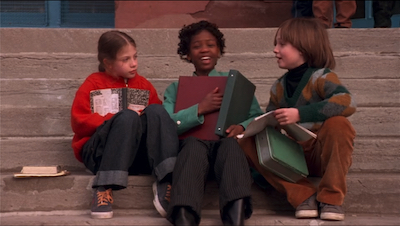 And this does seem more in that artistic lineage than other kids movies of the time. Harriet and her friends are funny and have a wry rapport. They’re like younger siblings of Sandy in FLIPPER who are way cooler than him even without Smashing Pumpkins t-shirts. Their clothes (sweaters, corduroy pants, Chuck Taylors, Keds, Doc Martens) could be worn by adult hipsters today. (Costume designer: Donna Zakowska, THE PALLBEARER.) Even though it’s elementary school, they’re already the outsiders sitting on the stairs making fun of popular Marion and her awful column in the class newspaper about horseback riding. But Trachtenberg never seems like some precocious sitcom wiseass. She has vulnerability under her cynical exterior.
In a 2019 interview, Hughes said
“I had one guiding philosophy in making HARRIET THE SPY, which was to take Harriet’s predicament as seriously in the filmmaking as it felt to Harriet herself. I remember at about that age feeling like the world was weighing down on me hard, and so the tone of the film needed to be through Harriet’s own experience. No condescending to kids. No rolling the edges off.”
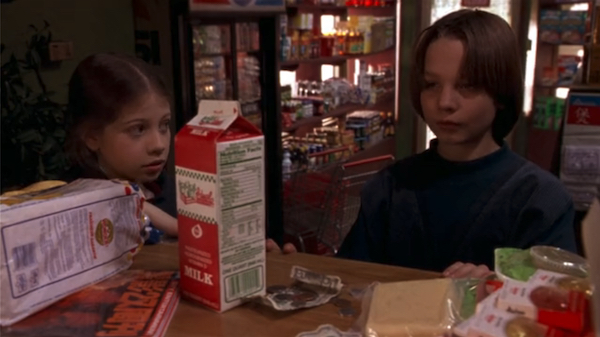
It’s a Cool Aunt approach to filmmaking for kids. Don’t pander to what they’re supposed to like, give them what you think they might appreciate being introduced to, like salsa music, or Eartha Kitt being a weirdo, or having their feelings acknowledged on screen. Like Fitzhugh, Hughes respects kids’ emotions enough to know they include sadness and discomfort. When Harriet sees Sport coming up short trying to buy a small amount of groceries, she recognizes the primary issue of not having the money, but also the secondary one of embarrassment. She comes in and pretends she saw him drop a dollar outside. He plays along, but we can see that he still feels humiliated. And they don’t even talk about it.
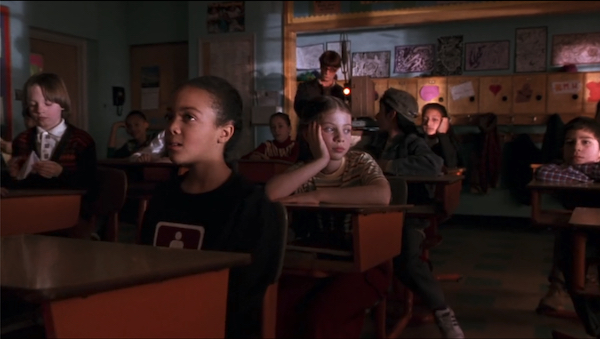
Harriet goes into a depression when Golly decides it’s time to leave. This shot of her not paying attention to a sex ed film always struck me as the type of thing that could be in THE 400 BLOWS or something like that. I remembered it as her looking out a window with rain dripping down it, but I guess that’s just the projector reflecting onto her face. Same feeling.
And there are harder struggles coming. The one time she decides to play with the other kids instead of spy she drops her notebook, and Marion reads it out loud so everyone can know what she thought about them. I love how these are lines we heard as narration and they seemed perfectly appropriate in that form, but harsh now that the kids she’s talking about are hearing it. Reminds me of the times when I’ve found out a filmmaker saw my negative review of their work. I like that Marion reads the key lines from the opening narration – “I learn everything I can and I write down everything I see. Golly says if I want to be a writer then I’d better start now. Which is why I am a spy” – and everyone mocks it. She watches them laugh at her very reason for being.
But the toughest part is Janie and Sport being hurt by what she wrote about them, and joining the others in ostracizing and harassing her. She’s a stubborn artist, she wrote what she felt was true, she doesn’t think it was wrong. Doesn’t regret it. Claims if she has to choose between spying and having friends she’ll choose spying. But it sucks to have everyone hate you. And to know you made someone feel bad. The montage where she successfully revenge-pranks everybody one-by-one is followed not by satisfaction, but crying into her pillow. She has to learn to apologize and have patience about being forgiven. HARRIET holds up “the truth” as sometimes being in opposition to being nice, and basically says you still gotta try to do both as much as possible. Doesn’t pretend it’s easy. “The truth is important, but so are your friends. And if you can have them both, then it’s a good life.”
The story stays fairly close to the book, with some updates like Golly leaving on her own accord rather than because she’s getting married. Greg Taylor (JUMANJI) and Julie Talen (an experimental filmmaker) are credited with “adaptation,” while Douglas Petrie (Clarissa Explains It All) and Theresa Rebeck (Dream On) get screenplay credit. They wouldn’t have known this at the time, but the 2020 biography Sometimes You Have to Lie: The Life and Times of Louise Fitzhugh, Renegade Author of Harriet the Spy by Lesley Brody revealed that Fitzhugh lived a life as off the beaten path as anyone in the movie. Her father was the son of a millionaire, her mother a dancer he met in Europe; they divorced when she was a baby and her father told her her mother was dead. During a college internship at a newspaper she learned the torrid facts of the divorce and never trusted her father’s family again. She did, however, receive an inheritance that allowed her to travel and study painting rather than take a day job. She started in children’s books as the illustrator for her friend Sandra Scoppettone’s Eloise parody Suzuki Beane, published in 1961, before coming up with Harriet. She wrote a few other books but really wanted to be know for something not for kids.
From the time she was a teenager, Fitzhugh dated and slept with both men and women, but seemed to prefer women, and ran with a crowd of lesbian artists in Greenwich Village. She died of a brain aneurysm in 1974, only 46, before she could come out, or publish her first adult novel, Nobody’s Family Is Going to Change, much less see it adapted into a Tony-Award-winning Broadway musical (The Tap Dance Kid, 1983).
After learning a little of Fitzhugh’s story I suspect the cluelessness of the parents and the fact that they dump Harriet off on a (very good) nanny is meant to be more acidic than it comes across in the movie. But I don’t think it’s wrong for Hughes to have empathy for them, treat them (and all the adults) as well-meaning people who get it wrong sometimes and right other times. The movie has enough edge that the sweet stuff feels authentic.
Although it seemed to me like it went unnoticed, HARRIET THE SPY wasn’t a flop. It made a little over double its budget in theaters, and I’m sure they were happy with all the bright orange VHS tapes they sold. FLIPPER grossed more, but probly profited less. I was surprised to see that HARRIET did better in theaters than many of the ’96 kids movies: ALASKA, BOGUS, D3: THE MIGHTY DUCKS, DUNSTON CHECKS IN, LOCH NESS. About the same as FIRST KID.
But it still seems weird to me that critics didn’t like it. I guess the generation getting published at that time wasn’t on this wavelength. Some of the reviews actually sound exactly like the 1964 reviews of the book, upset that Harriet can be angry and mean, like a human. They found her unlikable.
Roger Ebert gives it a fairly positive spin in his 2 star review, but agrees with the common claim that it just seems like TV, “more suited for the after-school slot on Nickelodeon than for theatrical release, where it simply isn’t in the same league as the THE SECRET GARDEN or A LITTLE PRINCESS” (outlier loved-by-critics family movies of the time, which seems unfair). The part that befuddles me most is when he concedes that “sometimes the materials of a movie like this work on audiences not much concerned with style or polish.” I felt at the time that this was a very stylish and well put together kids movie, moreso now that it’s a 30-years-ago period piece. If it didn’t have the Nickelodeon brand name, would a single one of them have thought it was like TV? I’m guessing no.
I watched HARRIET in my days as a multiplex projectionist, and I thought it was such an impressive debut for Hughes that three years later I watched her followup FORCES OF NATURE even though a Ben Affleck/Sandra Bullock romcom was not my thing. I do remember it being okay and slightly offbeat but not as impressive as I’d hoped from this director. Her third film, though, is a banger: the Thomas Jane South African bank robber movie STANDER (2003), which I saw it SIFF and tried to tell everybody about but not that many people listened. She’s only done two other movies, which I hadn’t heard of until now (OVER/UNDER [2013] and THE JOURNEY IS THE DESTINATION [2016]). But I guess the critics won because she does TV these days, including episodes of Berlin Station, 13 Reasons Why and a Better Call Saul.
At least everyone seemed to agree that Trachtenberg was outstanding. Though Harriet is said to be 11,Trachtenberg started filming on her ninth birthday. It’s sad now watching that tiny kid talk with Golly about what she’s going to be when she grows up, knowing that she died last year, even more tragically young than Fitzhugh. But like Harriet she followed her dream, she kept acting. I enjoyed her on Buffy the Vampire Slayer and in BLACK X-MAS. One of her last roles was a 2023 guest appearance as a different character on an animated series based on the original Harriet the Spy book (and from one of the creators of Pete & Pete).
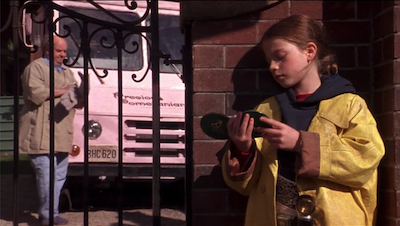 After she died I finally learned the answer to a question I’d always had about this movie: would kids who grew up with it see what I saw in it, or even more? The answer is yes. This is foundational for some of them. I can’t tell you how many tributes I found from millennial writers talking about how the movie inspired them to become writers, just as the book had for generations before. They talk about wanting to be Harriet running around scribbling in her notebook, and about seeing themselves in her outsider status, her troubles, her mistakes.
So it’s like I keep saying – some of the most special movies of Slam Evil Summer (or any period) are not the ones that were most celebrated at the time. “And each one deserves a closer look.”
* * *
Tie-ins: There was a Harriet doll. I was a little concerned to see a brush inside the box but not a notebook. Fortunately the box says it “INCLUDES: Belt – Binoculars – Camera – Private Journal – Rain Coat.” All the main accessories.
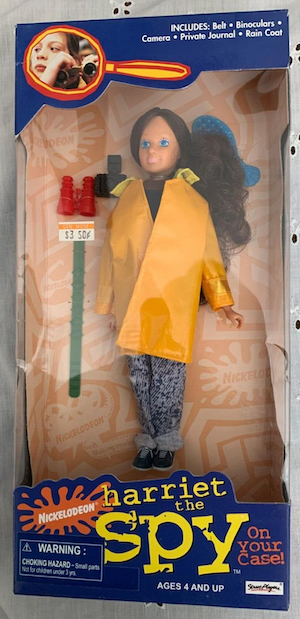
I’m surprised to find no evidence of an official journal or spy kit, but maybe they existed and just aren’t on ebay right now. Because they’re too precious, or too full of private thoughts you don’t want read out loud.
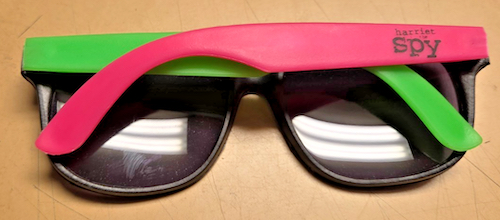
The only other merchandise I found was a pair of sunglasses, which I’d guess was a free promotional item. Enjoy the Nickelodeon-ish colorway.
Signs of the times: Though strategically free of Gameboys and other ‘90s shit, there is a scene where Harriet says “Talk to the hand, ‘cause the face ain’t gonna listen.” Fortunately she says it in that way of a kid reciting a thing they think is funny and repeat all the time, like the kids in STAND BE ME saying “I don’t shut up, I grow up, and when I look at you I throw up,” so it’s not cloying at all, it seems like real kid talk.
Additional notes: The pilot of Hey Arnold! played as a short before the movie. Not a cartoon I care about, but created by an Evergreen State College alumnus who did the Penny cartoons for Pee-wee’s Playhouse. Still reaching out to those indie artists.
O’Donnell won “Favorite Movie Actress” at the Nickelodeon Kids’ Choice Awards. One could argue against the ethics of Nickelodeon nominating their own movie (and the host of their awards!), but I’m gonna assume the kids voted for her fair and square over her competition: Whoopi Goldberg in EDDIE, Whitney Houston in THE PREACHER’S WIFE and Michelle Pfeiffer in ONE FINE DAY. (I’m not kidding, those were the real nominees.)
Trachtenberg and Chester won Young Artist Awards, though. That’s legit, I assume. Trachtenberg even won over Heather Matarazzo in WELCOME TO THE DOLLHOUSE! Chester tied with Claire Danes for TO GILLIAN ON HER 37TH BIRTHDAY.























July 16th, 2026 at 3:45 pm
Count Duckula, nice one Vern.