 July 24, 1996
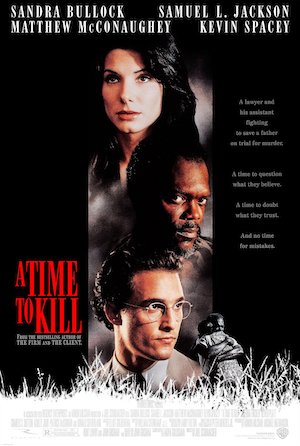
A TIME TO KILL is a court room drama, but it was in the top ten of the domestic box office for 1996. It made more than some noisier movies like ERASER, THE HUNCHBACK OF NOTRE DAME, BROKEN ARROW, and EXECUTIVE DECISION. That used to be a thing that could happen. Of course, it was kind a name brand, because it came from the first book by John Grisham, and there had already been movies of THE FIRM (1993), THE PELICAN BRIEF (1993) and THE CLIENT (1994). And this one came from the same director and writer as THE CLIENT, Joel Schumacher and Akiva Goldsman. (They sandwiched this between BATMAN FOREVER and BATMAN & ROBIN.)
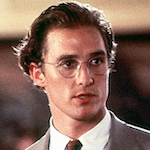
 I remember all the hype about Schumacher choosing the virtually unknown Matthew McConaughey for the lead role of Mississippi attorney Jake Brigance. The actor had made an impression in DAZED AND CONFUSED, and had recently been in LONE STAR, but most people had never heard of him, and this was his first lead role. Schumacher was talking him up as the next big thing, and it worked! Soon after this he did CONTACT and AMISTAD. Watching it now it doesn’t seem like that flashy of a role, it just seems like McConaughey, but I guess it was more exciting when it was new. He definitely stands out in the movie by being Texan and not doing an outrageous southern accent like Kevin Spacey and Donald Sutherland do.
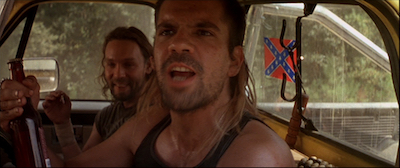
The movie starts with a horrific crime. Two racist redneck yahoos named Billy Ray Cobb (Nicky Katt, AMERICAN YAKUZA) and Pete Willard (Doug Hutchison, THE LAWNMOWER MAN) are driving around in a Confederate-flag-stickered pickup trick being white southerners in a manner that Joe Dirt would find a little too stereotypical. They’re throwing beer bottles, yee-hawing and being racist when they come across a ten-year-old Black girl named Tonya (Rae’Ven Larrymore Kelly, WHAT’S LOVE GOT TO DO WITH IT) on her way home from the grocery store. They (fortunately mostly off screen) rape and beat her and later when her father Carl Lee Hailey (Samuel L. Jackson, FRESH) embraces her barely alive body she whimpers that she’s sorry she dropped the groceries. Heartbreaking.
Everybody knows who did it. Sheriff Ozzie Walls (Charles S. Dutton, ALIEN 3) goes right to the bar where they drink and arrests them. When Jake hears from Deputy Sheriff Looney (Chris Cooper, LONE STAR) that they were arrested for rape he asks, “Who’d they rape?” and seems not to expect the answer to be upsetting. I don’t think it’s intentional but it’s establishing the movie’s world where how upset people get about a brutal attack depends on who the victim is.
Jake knows Carl Lee because he represented his brother once. Carl Lee shows up at his office, implies he’s gonna, you know… do something, and might need legal help. Jake’s wife Carla (Ashley Judd, HEAT) tells him he should tell the police, but he doesn’t. He kinda thinks he won’t do it, kinda thinks he should do it.
 Sure enough, Carl Lee shows up at the courthouse when the rapists are being transferred, shoots them both dead, also accidentally hits Deputy Looney in the leg, and it has to be amputated. He feels bad about that part. I like the scene where Sheriff Walls comes to his house to arrest him, he says goodbye to his family and comes peacefully, doesn’t pretend to have to be told what it’s about, doesn’t have to be talked into it, nobody has to say anything.
So the movie is about Jake being Carl Lee’s defense lawyer, trying to get him off an on insanity plea. It’s an uphill battle not just because Carl Lee is guilty and did it in front of almost every character in the movie, but because he’s being prosecuted by D.A. Rufus Buckley (Kevin Spacey in his followup to SEVEN) and the judge is the aptly named Omar Noose (Patrick McGoohan, THE PHANTOM), who denies a request to change venue, so they end up with an all white jury. I don’t get this part but Buckley believes the case is a godsend that will guarantee he’s elected governor. I know it’s supposed to be a racism thing but I just don’t buy that putting away the guy that killed the vicious child rapist scumbags would guarantee him votes.
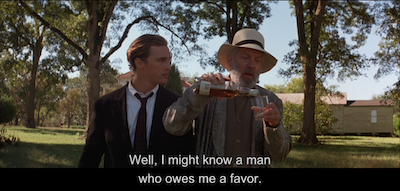
Jake could use some help, but he doesn’t accept it from Ellen Roark (Sandra Bullock, THE NET), a brilliant law student who shows up and hands him documents that save his ass in court and has all kinds of relevant experience and wants to work for him for free. Instead he tries to get his mentor Lucien Wilbanks (Donald Sutherland, BACKDRAFT), a once great civil rights crusader turned alcoholic disaster who was disbarred and says he will never set foot in a court room again, and his buddy Harry (Oliver Platt, DIGGSTOWN), a sleazy divorce lawyer. What the fuck, Jake, you fucking idiot. But obviously he eventually lets Ellen help and they get real close and it’s a good team.
Meanwhile, the late Billy Ray Cobb’s equally racist brother Freddie Lee (Kiefer Sutherland, THE COWBOY WAY) gets all the boys to come join the Ku Klux Klan with him and they start terrorizing Jake, his family, his secretary (Brenda Fricker, HOME ALONE 2) and her husband (Danny Nelson, FREEDOM ROAD). Kurtwood Smith (BROKEN ARROW) shows up a bit as a Grand Dragon named Stump Sisson, and M. Emmet Walsh (RED SCORPION) as an expert witness. And man, I thought that was her and sure enough Octavia Spencer appears briefly as a nurse, like she did in Rob Zombie’s HALLOWEEN II thirteen years later. This was her first movie.
One thing that’s distinctive about this movie is that Schumacher seems to be going for a world record of sweatiness. (I bet he noticed KAZAAM’s sweatiness too.) Nobody ever complains that it’s hot, but everybody has sweat on their brow, their cheeks, their collarbone, often soaking through the front and armpits of their shirts. Obviously outside is sweaty, and jail is sweatier than outside, but also the diner, the law office, the court room, the hospital, Jake’s house. I think the D.A.’s office has the only cool air in the region. I haven’t been to Mississippi before but in my very limited experience in the south I got the impression those people really had air conditioning figured out. According to this movie the electric fan hasn’t even made it down there yet. (Though there are hand fans in the Black church.)
Along with the sweatiness there is some sexiness, but no sex. I think the thread about the sexual tension between Jake and Ellen and him being able to walk away and stay loyal to his wife is effective, but it becomes comical when you learn that Grisham says the character is “basically me.” That’s probly why he vetoed Schumacher’s first choice of Woody Harrelson but was okay with the hot young new guy to play the great man who a brilliant, hot young student wants to fuck so bad but he’s too noble to let her. Congratulations, sir. No wonder you got a book and a movie.
(By the way, it seems like Ellen is supposed to be younger, being a law student while Jake has been working long enough to have his own practice, but Bullock is actually six years older than McConaughey. I think this a situation like Catherine Keener seeming to be in her twenties in WALKING AND TALKING – they were all new enough to the average viewer that they could fudge what age they were playing.)
Grisham said he conceived the book after hearing horrific testimony from a 12-year-old girl and wishing he had a gun to shoot the defendant. He spent three years writing it while he was a state legislator. It’s one of those origin stories everybody loves where it was supposedly rejected by 28 publishers before someone took it. (But it wasn’t a big hit until after The Firm.) Considering that he had been a lawyer and then was a politician when he wrote the book, it’s extremely cynical about the system. Carl is (understandably) so sure it will fail him that he doesn’t even wait for the trial to find out, he just kills the perpetrators. And then the righteous crusade to get him off requires an insanity plea that Carl says upfront is not true. “No matter what gets said in court, I knew what I was doing.” So kind of the premise is he has to convince the jury to do the “right” thing by doing the wrong thing.
There are a couple scenes where the jury decide to improperly discuss the case at dinner before deliberations. I think this is a smart storytelling choice because
1) it really shows that nothing in this case is going by the book
2) it shows us that the jury foreman (Terry Loughlin, ROAD-KILL U.S.A.) is totally comfortable calling the defendant the n-word and we don’t see anyone call him on it or seem bothered
3) and of course narratively it really shows the uphill battle being fought because we see that the jurors unanimously plan to convict Carl Lee.
So he has to change it in his summation speech, the one part of the movie almost as famous as Carl Lee yelling “Yes they deserve to die and I hope they burn in Hell!,” which I always think of in conjunction with “Give me back my son!,” “Get off my plane!” and “Show me the money!” But the people who said this was good (and there were many of them) didn’t cite the catch phrase, they cited the speech.
But I remember thinking this movie, and that speech in particular, were garbage. It’s obviously well produced and acted, it’s effective storytelling, but it grossed me out. Watching it 30 years later I really wondered if I’d been overreacting. I remembered one of the things I hated about it was that some hailed it as an important message about racism (as it is clearly intended), but it made its villains outrageously, outdatedly racist. Literally in the Ku Klux Klan, and protesting outside their courthouse in their robes. I felt it was a way to avoid talking about the actual racism people were dealing with in 1996 by portraying something out of a period piece, something that only existed on the very fringes that very few people would experience anymore. But of course, sadly, with the motherfuckers we’re dealing with in 2026 it seems tame.
On the other hand, I’d forgotten that it also portrays the NAACP as kinda sleazy opportunists who come into town and bribe the local reverend in their attempt to remove the heroic white lawyer (the real victim, really) from the case. The white man who gets crosses burned on his lawn, loses his home to a firebombing, the whole thing. When there are clashes between the actual hood-wearing white supremacists and the NAACP supporters on the streets I dearly hope I’m imagining it but it feels like we’re supposed to think well, both sides are really out of hand here. They’re all heated and a Black woman starts the violence by slapping a Klansman. We’re definitely not supposed to cheer for the kid who pops up on a roof with a molotov cocktail and sets the Grand Dragon on fire – save that for if the kid goes on trial and is found not guilty by reason of insanity due to the courageous trickery of a white lawyer. But I admit I did cheer. Death of the author.
(By the way, this somehow won NAACP Image Awards for Best Supporting Actor in a Film and Outstanding Motion Picture! For the latter it beat out COURAGE UNDER FIRE, GET ON THE BUS, ONCE UPON A TIME… WHEN WE WERE COLORED and THE PREACHER’S WIFE.)
Anyway I remember some of my co-workers at the time saying how moved they were by the summation speech, how it made them cry. Jake has the jurors close their eyes and then he emotionally and graphically describes the rape and beating of the little girl. (Earlier in the trial he wasn’t allowed to talk about that and now there’s not even an objection. The D.A. just gives up.) As I got closer to the conclusion I thought you know what, I must be remembering it wrong, it’s not really that bad. At the end he’ll say “Now imagine it’s your daughter,” because he’s just trying to make them understand the rage that Carl felt and that they would feel it too. This is what he and others have been saying throughout, that they understand him because they would’ve done the same. Now he’s getting the jurors to agree.
But that’s not what he says at the end. He says, “Now imagine she’s white.” They were upset, they were crying, but they were picturing the Black girl it happened to. When they picture her as white, that’s the kicker. That’s what switches their votes to not guilty. Oh shit, now that you put it that way, that was a really bad crime! And the thing is, it doesn’t come across as he recognizes the jurors are racist and he’s gonna pander to that to try to get these fucking numbnuts on his side. No, it seems like this is supposed to be a powerful argument that would sway anyone, that it will sway us as we watch the movie. That’s what my co-workers took it as! I couldn’t believe it. I guess it’s fair though for Joel Schumacher, the director of FALLING DOWN, to assume his audience is a bunch of racists. And he has to pull out the big guns to make them root for an anti-racist vigilante this time.
Yeah, that’s not so great either, the way it commandeers the tropes of sixties civil rights battles to make this seem like a righteous legal victory, when the law allows a revenge killing against the bad guys. The real case that inspired Grisham did not have the same racial dynamic; by adding it he can emulate To Kill a Mockingbird, but also add cover to his violent urges. To be fair, the real happy ending is the epilogue where Jake and Carl Lee’s daughters play together (and shake hands, my wife wanted me to mention, she thought that was ridiculous). So there is some optimism there. Maybe some day when they grow up they will, like, try to fix the legal system and people’s hearts and stuff instead of just kill the worst people.
I don’t like this movie.


















August 17th, 2026 at 8:50 am
I really disliked this when I saw it as a teen but couldn’t remember why. Reading your review brought it all back. After sitting through two plus hours of corny manipulation that “Now imagine she’s white” line was the kicker. The movie is straight up assuming its audience is racist and is trying to appeal to them on that level.