 August 30, 1996
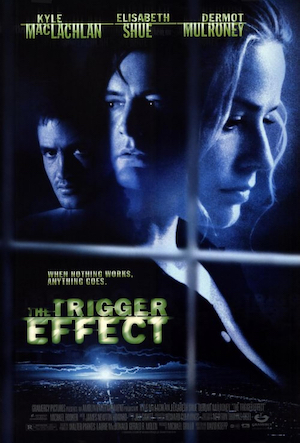
David Koepp’s THE TRIGGER EFFECT is the last movie in this review series that I hadn’t seen before. It’s not one anybody seems to talk about, so I could’ve gotten away with skipping it. I’m glad I didn’t, though. I don’t think it’s good, but it’s deranged in a really odd way that I appreciate.
 It opens with two coyotes playing tug-of-war with a dead animal, then howling, then walking past a power station. This is meant to encapsulate the movie because it’s about people not getting along during a power outage.
But for now the lights are on, and there’s a DePalma style tracking shot witnessing a chain of small conflicts between strangers at a mall: a drink spilled on a shirt, the person spelled on bumping into a lady and offending her boyfriend, etc. – and it’s a very unsettling intro because for one five minute shot we get this onslaught of characters and incidents where not one person ever reacts to anything in a way that seems natural to me. The culmination is in a movie theater lobby where a woman (Kerri Vickers) strolls past two long lines of customers, right up to the concession counter and just starts ordering. The person who was next in line, Raymond (Richard T. Jones, RENAISSANCE MAN), calls her on it, but she says, “Well, I didn’t see you” and goes back to ordering… so he leaves without buying anything.
 His movie has already started. He doesn’t know where his friend (Rick Worthy, RICHIE RICH) is sitting, and calls his name out loud. When he finds him he says that he doesn’t have popcorn because a woman cut in front of him, and his friend accepts that as an explanation. They continue talking loudly, upsetting our actual main characters, Matt (Kyle MacLachlan, THE FLINTSTONES) and Annie (Elisabeth Shue, THE KARATE KID), who are sitting in front of them. It’s setting up a dynamic here because Matt keeps looking over at them but doesn’t say anything, even when they call his wife a bitch, and she seems to hate his lack of action but doesn’t say anything to him about it. Then the power goes out for a few seconds and they act like that’s a normal thing to happen and a signal to change seats. (It’s actually a wise and peaceful solution but just doesn’t feel like what humans would do without at least grumbling about it.)
At home things are stressful because the baby has a fever. And there are definitely some issues in their sex lives. Annie takes off her shirt, starts playing with one strap of her fancy bra, caressing herself like she’s in some Playboy Video Calendar or something. When Matt finally notices he doesn’t go over to her, he beckons her to where he is, sitting on the bed in his dorky undershirt and boxers. Then the baby cries, she loses rock-paper-scissors, he lets her take care of it while he returns to doing nothing.
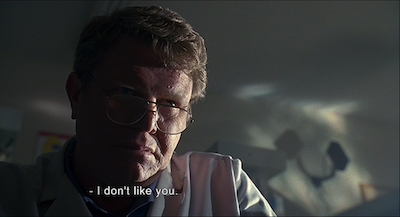
When the power goes out at night that doesn’t seem that unusual. But it’s still out the next morning, and the baby is even sicker. Matt tries to get her medicine from the grocery store, but the pharmacist (William Lucking, EXTREME JUSTICE) says he can’t do it because with phones not working he can’t call in the prescription. Matt really needs that medicine, so I can forgive him for holding up the very long line a bit to plead his case. But he chooses the entitled “long time customer” routine, refuses to accept the answer he’s given, and is insulting enough that the pharmacist coldly tells him, “I don’t like you.” I’m really not sure if we’re supposed to agree with the pharmacist, but I absolutely do. I’m certain Matt has been a pain in the ass previously, in non-disaster scenarios, so I’m happy for this pharmacist that he had a chance to speak freely. You suck, Matt. And you need to know it.
Later Matt gets desperate, comes back to the store, sneaks behind the counter and steals the medicine. Another customer sees him and doesn’t rat him out. He gets chased but gets away. When he tells Annie he did that she gets turned on and straddles him. The baby’s not crying because of the medicine, so this time the cockblocker is someone peeking in the window who turns out to be Annie’s friend Joe (Dermot Mulroney, SURVIVAL QUEST).
I like that a woman is allowed to have a straight male best friend in this movie – that’s uncommon. But it’s not exactly the most positive portrayal of male-female friendships since his main function in the story is to make Matt uncomfortable by having obvious sexual tension with Annie. She invites him for a “sleepover” to hang out with them while the power is out and is not subtle about her attraction to him and/or the idea of her husband seeing her attracted to him. Some highlights:
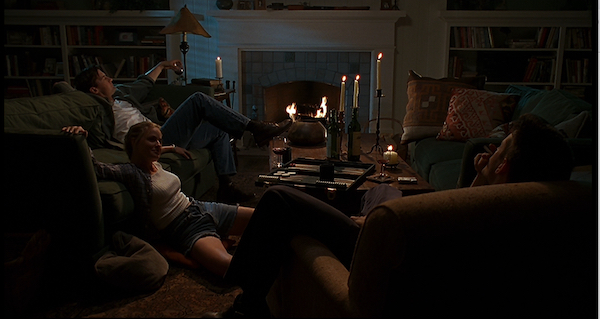
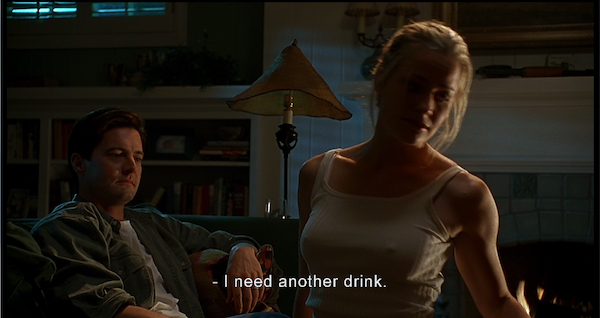
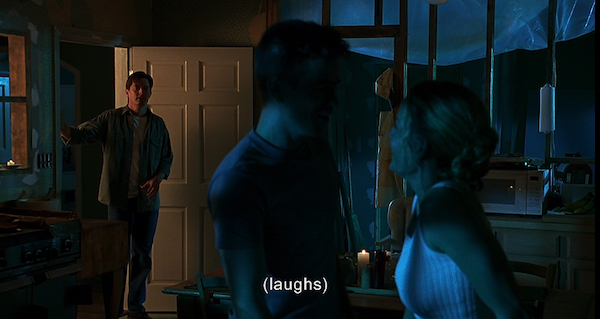
But also getting these two boys together is trouble because Joe convinces Matt they should “not be naive” and get a gun for protection during the power outage. Who knows what kind of crazy shit could happen out in the suburbs when there’s no TV to watch? Better have a tool for quickly ending human lives, just in case. Everybody’s thinking that way. At the gun store there’s a long line and the clerk (Richard Schiff, THE ARRIVAL) is accepting everybody’s expensive watches as trade-ins.
That very night Joe wakes Matt up because a burglar (Jack Noseworthy, BARB WIRE) is in the kitchen. Turns out Annie threw their new shotgun in the pool, but “he’s just a little guy” so they take a baseball bat and a knife and confront him, and as they’re arguing out front their across-the-street neighbor Steph (Bill Smitrovich, THE PHANTOM, INDEPENDENCE DAY) shoots him. (Don’t worry – Steph has an unregistered gun to plant on the body.)
There is a theme of class tension. Joe takes offense at a weird thing Matt says about him being better at talking to the gun store clerk because he works in construction. Matt gets furious when Joe teases him about stealing the medicine, calling it looting. “I’m not a looter, Joe. I took what I took to fill a specific need.” He’s sure he’s not one of those people. And there’s a whole thing where he’s missing a watch and Annie thinks “workmen” working on the house took it, while he thinks “we mislaid a few things, that’s all.” But she’s right, because the dead burglar was the guy fixing their kitchen, and he’s wearing the watch. Koepp seems to not like Matt’s condescending attitude toward the working class, but share Annie’s paranoid view of them.
His treatment of the racism theme is similar. The movie definitely sympathizes with Raymond and points out the unfair way white people view him, but doesn’t mind introducing him in a pair of Black men being obnoxious during a movie, calling a woman a bitch and seeming to want to start a fight in the lobby later. Still, Raymond has plenty in common with Matt, including choosing whatever wack ass movie this is over CLOCKERS playing in the same theater.
Matt and Raymond actually cross paths at the gun shop, but they don’t notice each other. An hour in Joe walks past him at a truck stop, and then the movie switches modes to stick with Raymond for a minute. He’s nervous about all these rednecks staring at him, and about some unseen person he’s waiting for who’s in the bathroom. Then a guy named Gary (Michael Rooker, LIGHT OF DAY) comes in and asks if he can spare a little gas, kinda hassles him about it and he refuses. And you get it, because it’s Michael Rooker. Everything he says seems like an implied threat.
A bit later Matt, Joe and Annie come across what they think is an abandoned car and try to steal its gas until it turns out Gary is sleeping in it. He asks them for a ride and they tell him they can’t. Joe notices he has a gun in a holster, takes it as a threat, and gets the shotgun from the car, so Gary shoots him. He immediately starts saying, “Why’d you do that?” and it becomes clear that even though he’s Michael Rooker he really did just need help. I guess this is a point of unity between all races and cultures: we don’t trust Michael Rooker.
I always assumed the title was about events triggering each other, but I guess it must be at least in part referring to guns. I do appreciate that it illustrates my view of guns quite well. These macho assholes believe it’s a fact of life that you need to have a gun in case some shit goes down. And then the presence of a gun either makes the shit worse or is in fact the cause of the shit going down. Steph didn’t need to kill a guy for stealing some stuff from Matt’s kitchen. Joe didn’t need to point a shotgun at Gary for needing a ride, and Gary didn’t need to shoot Joe for pointing a shotgun at him. Guns don’t kill people, dumb assholes who think they need guns kill people using the guns that they think they need.
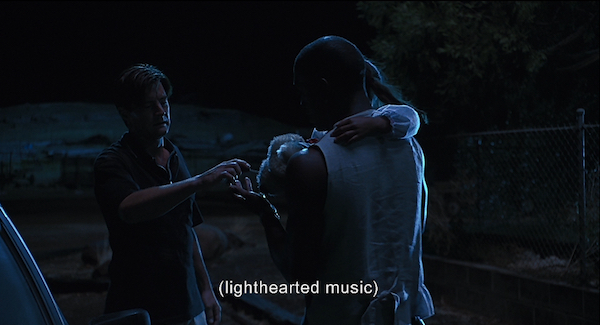
All the storylines and themes come together when Matt goes looking for help getting Joe to a hospital, knocks on a door and it’s answered by Raymond. Matt knows he looks familiar but doesn’t remember it’s from the movie theater. He asks to borrow his car, but Raymond doesn’t believe his story and won’t help him. Matt has the audacity to accuse him of not really living in the house, and threatens him until he pulls a gun. So Matt goes back to the car, gets the shotgun, and tries to repeat his pharmacy victory. He sneaks in to steal the car keys, but gets caught in a stand off.
The message of peace in THE TRIGGER EFFECT is that they start shooting but it turns out Raymond has a young daughter there (that’s who was in the restroom at the truck stop) and as soon as Matt realizes that he apologizes, says he didn’t know, puts his gun down and says he’s taking the car and will bring it back. Since he put the gun down Raymond decides to drive him himself. See, we just need to trust and help each other, even the people who talk during movies.
This was Koepp’s feature directorial debut (after a short in ’94). He’d come up as a screenwriter of small-ish movies including our beloved I COME IN PEACE before DEATH BECOMES HER broke him into the big time and then JURASSIC PARK must’ve set him for life. He’d had THE SHADOW in ’94 and MISSION: IMPOSSIBLE a few months before this and he was already working on THE LOST WORLD: JURASSIC PARK so I don’t know, maybe he was the type of guy who had multiple Rolexes that could be “mislaid” or stolen by “workmen.” He was definitely the type of guy who was close enough to Steven Spielberg to get Amblin Entertainment to produce this weird, horny, preachy, sort of disaster sort of thriller drama. Good for him, I think.
In my review of HAMNET I noted that it was an Amblin production and “For now on when people use ‘Amblin movies’ as shorthand for ‘movies like GREMLINS and GOONIES’ I will assume they also mean movies like HAMNET.” Well, I’m gonna change that to “Yeah, Amblin – movies like HAMNET and THE TRIGGER EFFECT.”
Reportedly Koepp was inspired by the Twilight Zone episode “The Monsters Are Due on Maple Street” (about happenings in a neighborhood during an alien invasion) and the ‘70s BBC science show Connections (I’m not sure how). There’s nothing really sci-fi here, but I guess it has that Rod Serling mix of pulpy and thriller-y but preachy. It’s less self-important but it reminded me a little bit of notorious best picture winner CRASH with its theme of we are all connected, we are all a bunch of crazy assholes who openly fear and hate each other, we can all be magically cured and get along though. (I guess that’s a little bit parallel to A TIME TO KILL too.)
I’m not sure what I would’ve thought if this if I’d seen it in ’96, but thirty years of world events and life experience have led me to feel different about its cynical idea that just the power going off for a couple days would turn everybody into maniacs. I think it feels wrong because despite all of the long term societal repercussions of the 9-11 and COVID-19 aftermaths, I also remember what those days were like in the moment, and in my experience most people were trying to help each other, to find connection and unity. The long lines trying to get toilet paper and yeast were sharing the stress together more than they were fighting each other. People were having vigils and starting canned food banks and arranging to deliver groceries to elderly neighbors and things like that. So this assumption in decades of post-apocalypse pop culture that you can’t trust anyone and everyone’s out for themselves and all that – I have come to believe that it describes a minority of selfish assholes, but not human nature. Those stories kinda serve as accidental propaganda for the assholes to try to convince everybody that their character flaws are the standard.
So to me most of the events of THE TRIGGER EFFECT feel unlikely and off base, sometimes comically so. On the other hand, there’s obviously something poetically true about good-looking, ostensibly reasonable upper class suburbanites having to face that they’re not the great, upstanding people they believe they are. And I like that Matt’s attempts to go against his standard wimpy behavior and “man up” always turn out disastrously for him. Also, Shue gives a really outstanding performance in an almost separate storyline about having more sexual chemistry with her pal than her husband. It’s probly there mainly to push Matt’s buttons of male vulnerability, but I’m more compelled just by what she’s going through than what it does to him.
THE TRIGGER EFFECT was a limited release (it actually premiered at the Seattle International Film Festival) and did okay. Its reviews were also okay. Some criticized the “safe” ending, which seems silly to me, because imagine how much even-cornier it would be if its point was not “maybe we can get along” but “dude, people can NOT get along – AM I BLOWING YOUR MIND!?” That would not have been a good movie.
I guess this isn’t either. But I can’t deny I’ve been excited to write and talk about it and try to describe it. It’s definitely interesting.
Slam Evil Summer connections: Greg Grunberg, future J.J. Abrams regular who had a bit part in THE PALLBEARER, plays the guy on the date with the lady who cuts in front of Raymond.
tie-ins: There was a novelization by Dewey Gram (A Perfect World, Maverick, True Lies)




















September 16th, 2026 at 9:39 pm
I saw this when I got back to college in ‘96 and was underwhelmed then. Now it seems it’s not the crisis that brings out the toxic behavior but the return to “normalcy.” Since the world reopened years ago people have been acting aggrieved and entitled. Which, come to think of it is Joe they were acting before 2020. I don’t want to watch this again but Koepp’s delivered good pulp with Premium Rush.