
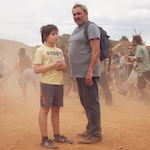
 SIRĀT is an unusual movie – a Spanish film from French-Galician director Óliver Laxe, set in Morocco. It follows a man named Luis (Sergi López, PAN’S LABYRINTH), who brings his young son Esteban (Bruno Núñez) and his dog Pipa to a rave out in the desert while searching for his missing daughter. (They’re not dancing, they’re just walking around showing people her picture.)
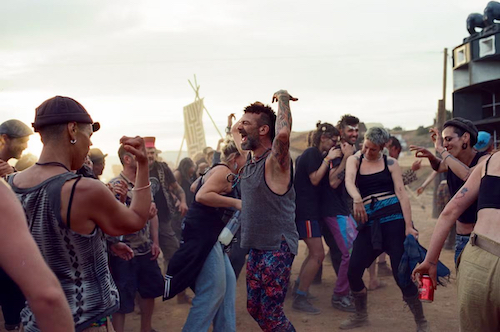 The movie is simple, primal, artfully repetitive, hypnotic. There’s nothing but sand and a few people, they set up their speakers, they put a beat on. It takes a long time before it changes at all. The droning on and on is the point. It makes perfect sense that the two Oscar nominations this got were for Best International Feature Film and Best Sound. Funny to think about Academy voters watching very long scenes of what seems to just be real people letting loose in the desert. Ha ha, you had to watch that for your consideration.
The event gets broken up by soldiers declaring an emergency, but two RV-loads of European ravers who Luis talked to earlier make a run for it, heading to another rave they say will be happening deeper in the desert. So Luis follows this mini-convoy of grizzled punks in their van, making a dangerous trek. It’s a little bit SORCERER, with faint traces of FURY ROAD, but with more thumping beats (courtesy of French DJ Kangding Ray).
They hear some radio reports about an escalating conflict, but they turn it off. There’s an eeriness, but also an appeal, to the implication that disaster might be ravaging the outside world and they’re just staying out of it, keeping it out of mind. They’re in their own world, away from it all, an extension of the very act of raving, of letting go of all your self consciousness and inhibitions and just moving your body to the beat. Free your mind and your ass will follow.
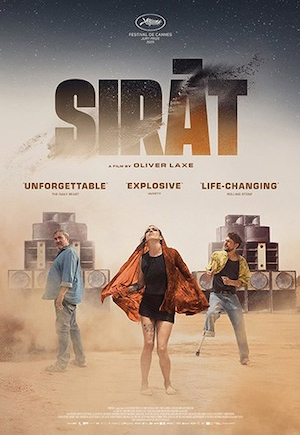 Part of the appeal is the unlikely bonding between these two very different parties. The ravers Bigui (Richard Bellamy), Stef (Stefania Gadda), Josh (Joshua Liam Henderson), Tonin (Tonin Janvier) and Jade (Jade Oukid) are all played by non-professional actors, a super team of real life outliers they recruited to pretty much be themselves within this fiction.
I didn’t notice at first that two of them are amputees. Maybe that nudged them along toward an outsider lifestyle, maybe not. But it’s not a big deal to anyone here. Tonin does a little puppet show using his leg stump as the face. I like that they’re all so weathered. This is not a youthful phase for any of them. This is permanent. “You think this is a fuckin costume? This is a way of life,” to quote Suicide from RETURN OF THE LIVING DEAD.
I don’t think they look down on Luis, this normie trespassing into their scene with motives that are understandable but unrelated to their own. They definitely seem to have sympathy for him, but they’re skeptical that he can hang, that he really understands what he’s getting himself and his vehicle into, and they worry he’s gonna get stranded. He gains a little respect by giving them money, buying the fuel they need to continue the trip when it looks like they won’t be able to. And he just keeps persisting, so they let him join them.
There’s still some tension when he’s pressured to share his food rations with everyone else. It’s uncomfortable for a minute but I think he comes around to an understanding that this is the system he’s asked to be a part of. It makes sense.
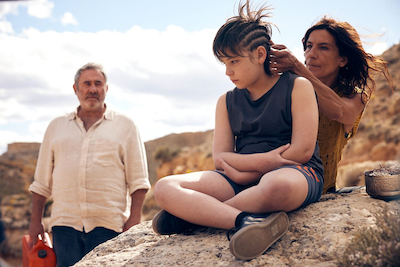 It’s touching to see him earn their acceptance, but also to see him never judge them, and to see Esteban admiring them, wanting to be like them, having them cut his hair. And there’s something so beautiful about just being out in a void, nothing visible on the horizon, your big buses and your friends, drugs for those who partake, the loudest bass imaginable for all. What else do you need?
I really didn’t know much about this movie. I thought I heard something about it being dark or apocalyptic or something, but it spends enough time being free and kinda mellow and relaxing that it really tricked me. There’s a point pretty late in the movie where something extremely upsetting happens very abruptly. (SPOILER: the van rolls off a cliff with Esteban inside. That Luis was worried about him and made him get inside for safety makes the burden on him even heavier.) Luis goes into shock and I feel like we do a little too. What the fuck now? He’s still trying to find his daughter, and then he’s going to tell her her brother died along the way? And shit gets even worse. There’s a succession of tragedies, but there is no intention, no specific perpetrator, no violence. It’s all accidents. They traveled so far to get away from the world but there the world is, in the form of unexploded land mines from some past conflict.
My favorite fact from the Wikipedia page: “Laxe had considered making a film based on the simple concept of ‘trucks crossing the desert.’ In 2011, he wrote a treatment about a truck race, which he likened to the TV series Wacky Races, but the project ultimately went unmade.” Make the call, Hanna-Barbera. You know you want to see it.
SIRĀT doesn’t remind me of Wacky Races, personally. It’s not a race and the wackiness quotient is low. There’s a dialogue exchange I wrote down, and I don’t remember precisely when it happens in the story, but it captures some of the foreboding feeling of the movie, and the reason it feels timely.
“Is this what the end of the world feels like?”
“I don’t know, Bigui. It’s been the end of the world for a long time.”
Ultimately I interpreted the movie as extremely pessimistic. There’s a bit of a FINAL DESTINATION sense of doom there. You can’t escape it no matter how far you drive. And yet, would you tell them to do anything differently? For Luis to just let his daughter go? For the ravers to evacuate on soldier’s orders? Or to put on khakis and live in the suburbs? I don’t think so. They’re doing what they gotta do. Maybe that’s all you can do, and hope for the best.





























June 17th, 2026 at 9:53 am
masterpiece SIRĀT was my #1 of 2025 from when I first saw it in August of last year until earlier this month when I saw Alex Bakri’s documentary HABIBI HUSSEIN. Great review, as always!