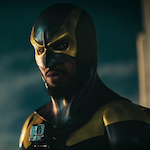
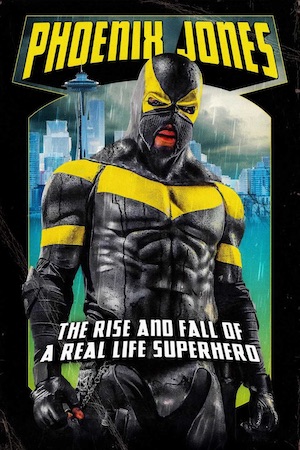
 PHOENIX JONES: THE RISE AND FALL OF A REAL LIFE SUPERHERO is a new documentary I saw at the Seattle International Film Festival last weekend. I didn’t want to miss it because it’s a local topic so I didn’t know if it would ever get a real release, but I guess it premiered at South By Southwest, and now that I’ve seen how legit it is I expect it will get out there.
If you’re not familiar, Phoenix Jones was the moniker of a guy in Seattle who, around 15 years ago, regularly patrolled the streets in a superhero costume, attempting to fight crime. People say he became a folk hero, and that description will have to do, but I don’t think it was a “crime is out of control and finally someone is doing something about it” type reaction like you see in the movies. We were proud of our city spawning a strange phenomenon, but we didn’t necessarily think it was useful. I think people were fascinated with the question of what kind of a nut and/or dork would do this, and what would happen to him.
The last question was partially answered in real time by the livefeeds of Phoenix’s bodycam and his videographer Ryan Mcnamee (who provided his footage and is interviewed in the movie, but died before it was completed). I remember being particularly fascinated by the video where a guy challenges Phoenix to a fight and Phoenix claims (without disagreement from a police officer called to the scene) that in Seattle we have a “mutual combat law” so you can legally consent to a duel. Phoenix dances around, kicks the guy on the leg a couple times, knocks him to the sidewalk and it’s over. (The guy probly didn’t know about Phoenix’s amateur MMA record of 15 wins and 2 losses.)
The one time I spotted Phoenix Jones in person was near where that fight happened. He was walking with purpose on the other side of University Way, accompanied I believe by his colleague Midnight Jack. It was just some masked dudes headed in the other direction, but it felt like a celebrity sighting almost on the level of when I saw Sir Mix-a-Lot leaving a restaurant as I was going in (R.I.P. Tup Tim Thai). Later Phoenix got into some legal trouble that exposed his real name, but he kept going. He did some pro MMA fights. He got some customized Nikes. He had a short book written about him by Jon Ronson, the author of The Men Who Stare at Goats. Eventually he got into more scandalous legal trouble that sullied his name. And the world moved on. But now director Bayan Joonam (who did the Vice series QAnon: The Search for Q) has made the definitive portrait of Seattle’s self-proclaimed guardian.
 It’s easy to picture the lightweight, obvious version of this, a sort of summarized Wikipedia article with wacky music and “Can you believe this actually happened!?” talking head interviews where you come out with only a little more detail on what you already knew. Thankfully this is something much more interesting, mostly a character study of an unusual and complicated person. It does answer many of the questions we’ve had (or never thought to have) about Phoenix Jones, but it retains a sense of mystery, because one of those answers is that real people are more complicated than comic book characters who can be slotted as either heroes or villains.
It’s also made with pretty good taste. Even the inevitable use of generic “comic book” imagery is light – they opted to use a few text boxes, but mercifully no shitty animation, printing dots or freeze frames that turn into traced over comic panels; a few inserts of the supers flatteringly posed in cinematic lighting does the job. As far as celebrity interviews we just have Rainn Wilson, and he turns out to be part of the story, first when Phoenix dramatically approaches him and James Gunn during a SUPER panel at the Emerald City Comic-Con, and then it turns out he took Phoenix around Hollywood to pitch a reality show. (It’s weird that he befriended a real life superhero by making a movie about how fucked up you’d have to be to want to be a real life superhero.)
Otherwise maybe the most famous interviewee is Seattle rapper Sol, a very important voice in the movie because he grew up with Phoenix, has great love for him and says wryly that their “paths diverged” after the night his old friend (cousin according to Wikipedia) came over with two ski masks and said they should go fight crime.
The movie starts almost like a flash forward. It’s during COVID lockdown, after the murder of George Floyd, a time of civil unrest in Seattle. I want to note as someone who lives here that the burning cars and smashed windows that look so shocking in the news footage were contained to just that spot you see and cleaned up fast enough that I never saw the wreckage myself. But obviously it was some crazy shit, and when people on Twitter started asking why Phoenix Jones wasn’t intervening, he decided to suit up again and go where the action was. I suspect he recognized that those people might have been joking, but that’s very in-character for the man as portrayed in this movie: if there is a dramatic way to spin it, that’s what he will do. So as far as he’s concerned, the people were crying out for his help, and he couldn’t ignore the call.
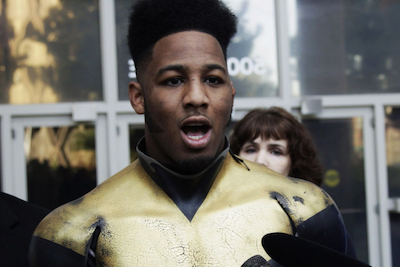 The documentary crew is there as Phoenix does a phone interview about it with a (scummy right wing) local radio host who asks why people should listen to him about the law when he is himself facing charges for selling drugs to undercover officers. (You knew this if you followed his story, but otherwise it’s a hell of a plot twist.) Joonam leaves that hanging and jumps back in time to summarize what was previously known about the man in the rubber muscle suit who started what they called “the Rain City Superhero Movement.” The first major swerve in that story is when Phoenix and crew run up on what they claim was a huge fight, but seems to have been a misunderstanding, judging from what the people he pepper sprayed told the police, and from Mcnamee’s hilarious video of a woman angrily chasing Phoenix and trying to hit him with her shoe. Since he was arrested for the fracas, his real name became public record, and he called a press conference to (as the movie points out) unmask himself in the cinematic fashion he preferred.
At this point in the documentary, Ben Fodor a.k.a. Phoenix Jones opens up, telling us about growing up with his two adoptive moms and his adopted brother Caros, who shares his passion for MMA but not his outgoing personality. We hear what Fodor always said was his origin story, when his son Freedom was cut by shards of glass from someone breaking into his car and he got so mad he wanted to prevent that from happening to anyone. But also we get to meet Freedom, now a very thoughtful teenager who is proud of his dad (despite avoiding the topic at school) and empathetic about what he says is his dad’s severe trauma.
We even get to meet the man who made his supersuit, Lance Coulter of Xtreme Design FX, a guy he called with a disguised voice and said he’d never know his real identity. (Both parties laugh about this now.) He confirms that he based it on the 1989 BATMAN suit and says that Fodor asked for Egyptian-style gold bands on the arms.
Most of the other Seattle superheroes have less elaborate costumes (two of them just look like amateur cops in their interviews, sitting in chairs wearing kevlar). One of the best characters in the movie is the aforementioned Midnight Jack, allegedly a former criminal, who does his interview in his black and silver Spider-Man mask with a leather jacket and Converse. (He was at the screening wearing the mask with a black button up shirt and tie.) Seeing him behind Phoenix back in the day I pictured him as some doofus hanger-on, but here he’s a really brash and funny dude who loves talking shit about what he now describes as “my time in a cult.” Also there’s an awkward moment when the crew is going to walk unless he gets rid of the gun he has on him.
Everyone talks about Fodor’s charisma, and many of them talk about his tendency to exaggerate and self-mythologyize, which go hand in hand and are on display in the clips and interviews. I came out liking him even though so many of his flaws are hung out on a clothesline for all us neighbors to see, and even though it’s made clear that there’s some level of unreliable narration at play here.
The dramatic event I had no idea about is when Phoenix and his team were right there when a shooting happened. Phoenix ran after a guy with a gun and it’s ambiguous whether he just lost him or was afraid to turn the corner after him, but then he saw a bystander caught in the crossfire fall dead. He talks about watching the fire department wash the blood away while he sat on the curb feeling useless, knowing that his presence made no difference, had no chance of making a difference. The gunman he saw turned out to be the target, not the shooter, so even stopping him wouldn’t have helped anything.
The way the movie tells it this incident broke Fodor. He was disillusioned, his friends say he was behaving erratically, there were questions about money, he started using drugs despite a previously almost juvenile opposition to them (one bizarre clip shows him angrily taking crack pipes away from junkies and breaking them). His wife, a fellow superhero named Purple Reign, gets fed up and divorces him, so we have the rare experience of seeing an apparent breakup fight during a patrol live feed. Having retired, he started doing security for an apparently disreputable dance club, which led to participation in selling MDMA and the undercover bust. His defense is that his roommate was the dealer, he was just giving him a ride and got baited into handing the bag over, but did know what it was and accepted money for it.
So with some genuine riots happening (but mostly just protests), and with a documentary crew in town to make a movie about him, of course he was too tempted not to get back into the fray. The shoot coincided with the three weeks in June of 2020 when the Seattle Police Department performatively abandoned a precinct headquarters and the protesters they’d been facing off with humorously called the area the Capitol Hill Autonomous Zone (CHAZ), later renamed the Capitol Hill Organized Protest (CHOP).
This happened after weeks of tense standoffs between anti-police-brutality protesters and police who enthusiastically engaged in said brutality, beating, choking, tear gassing and flash banging peaceful protesters, including children, and preventing them from getting medical help. Things got even worse when a man drove his car toward a crowd of protesters, shot one who tried to stop him, then ran directly to a police barrier and they let him in because his brother was a cop!
Whatever was going on there, it fueled understandable paranoia. At the request of Mayor Jenny Durkan, Police Chief Carmen Best announced they were removing barriers around the East Precinct and allowing protests as an act of de-escalation. But an assistant chief went over the women’s heads and they boarded up and vacated the building, reportedly leaving the doors unlocked! They also started a disinformation campaign by giving fake reports over the radio about Proud Boys headed to attack the CHOP, which caused anti-fascist but pro-open-carry dudes to appoint themselves as “security.” More dangerous Phoenix Joneses.
I remember getting a phone call from an aunt making sure I was okay. I told her that was the other side of town but my understanding from people in the neighborhood was that it was mostly people singing, handing out free food and water and planting a community garden in the park. I can’t claim to know that much about it – it was pre-vaccine so I stayed home. But it really pissed me off to see people on TV and social media talking shit when they clearly knew even less about the culture and history of the city and neighborhood than they did about what was going on there.
But before it was over there were several shootings near or in the CHOP. The only one that involved the protester camp was when some teenagers crashed a stolen SUV into the concrete barrier and (according to some witnesses) the aforementioned armed security goons thought they were attackers and shot at them. In all cases the protest’s volunteer medics had to treat the victims and drive them to the hospital because the police wouldn’t allow ambulances or the fire department to enter. The city has since spent many millions on settlements over this stuff.
None of that is in the movie, but there is a crazy scene where Phoenix responds to a “hostage situation” that turns out to be the owners of an auto shop who caught a guy who broke in and started a small fire on their counter. They don’t know what to do because the police and even the fire department are using the business’ proximity to the CHOP as an excuse not to show up. They seem to have decided to let the intruder go when a group of protesters show up and knock over their fence.
It’s unclear from the movie and the media coverage at the time (which does not mention Phoenix) why they did this or what they thought was going on.
But it’s a fascinating situation for PHOENIX JONES because here we have a genuine conflict between differing parties about community policing, and a superhero shows up to help, and all that does is cause everyone to yell at him. He ultimately finds that the way to create calm is to go sit down out of sight and stay out of it, which is in fact the exact thing police always do once the mayor or someone tells them to stop beating the shit out of protesters. They drain the city budget on meaningless militarized terrorizing of citizens until it looks bad enough for higher ups to tell them to knock it off for a minute, the next day there’s another protest but instead of throwing a hundred Project Grizzly bozos to shoot toxic chemicals at hippies there’s like 10 bicycle cops hanging back a couple blocks behind and whattaya know, nothing happens except some marching and chanting and then everybody goes home. Rinse and repeat forever.
These are complicated ongoing problems with many possible solutions our society refuses to try. None of them involve Judge Dredd or Batman. Despite all of Fodor’s passion and good intentions, the incoherence of his philosophy becomes apparent the moment he shows up to the scene of a protest or looting, gets called a cop or a sellout, and tries to explain that they’ve got him all wrong, he’s on their side, or on no side. Particularly embarrassing is the 2012 footage of a clash with May Day protesters. He claims he’s there to stop someone from bombing a courthouse (based on intel even the cops don’t believe). When protesters yell at him for pepper spraying them, he says, “We didn’t pepper spray anybody!”
“I did,” admits Midnight Jack.
“Oh.”
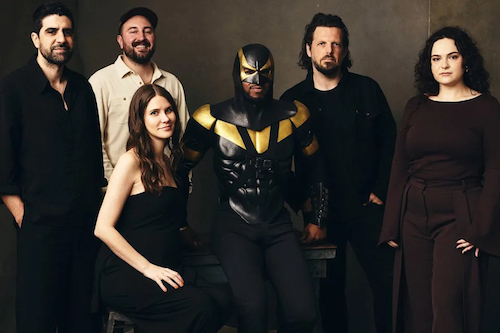
I didn’t mind, but the movie felt a little long to me, and Joonam said it was a special Seattle-only extended cut. Clearly there was a ton of material to consider and whittle down from. In the Q&A someone asked why it didn’t mention Rex Velvet, a self-proclaimed “Real Life Supervillain” who taunted Phoenix on Youtube. Joonam said he reached out to the guy but decided he didn’t want to waste screen time on something that wasn’t even real when he was dealing with the aftermaths of the drive-by shooting and the protests. I think that shows why this is the better version of this doc than the one you might’ve imagined.
However, a strangely under-addressed topic I wonder about is Fodor’s comic book fandom. We gotta assume he grew up on them and/or still loves them, but maybe not? I don’t think it’s discussed here. I wonder whether specific characters influenced his ideas of justice and the fantasy role playing he’s engaged in, or whether it’s just the general cultural idea of the superhero. Either the answers to these questions weren’t very entertaining, or Joonam just isn’t a comic book guy. He didn’t know to compare Phoenix coming out of retirement to The Dark Knight Returns.
Some would say that super hero stories are our culture’s collective ideals expressed as myth. But what happens when you take a reality translated into myth and then translate that myth back into reality? Something gets lost. Fodor is more self-deprecating than you might expect, and couldn’t be clearer that he wants us to take this as a cautionary tale. Of course, “don’t dress up as a superhero and try to fight crime” is not a lesson most people need to learn. If that was a normal thing to do nobody would care about Phoenix Jones.
And in a way that’s actually the lesson I personally take out of it. Here is a guy who is clearly in pain about being given up by his biological parents, and surely other things. He has a loving and interesting family but still suffers from some sort of self esteem issues judging by the grudge he holds over his MMA match against his brother. Surely he’s working out some frustrations with his night time activities, but he’s also seeking validation. This need for attention brings him notoriety but also embarrassment, having appointed himself as a moral authority and then undeniably violated his own code. But he’s funny and charming, he seems to be (and by all reports is) a loving father, he can definitely tell you some great stories, most of them at least partially true, he’s a truly unique guy.
In short he is a human being, like all of us both an amazing person and a total idiot, a great dude and a fuckup, a layered individual with strengths and weaknesses, and he deserves love and happiness like everyone does. I share a city with him, I’ve seen him across the street, I know most of the blocks he’s shown on in this movie, but I never would’ve heard of him if not for this extreme thing he did. Just like I wouldn’t’ve cared about Batman if he wasn’t swinging in and punching dudes. But I wouldn’t’ve loved him if he wasn’t trying to help Clayface and Manbat, or showing empathy to Baby Doll when he catches her.
Who was there for Ben Fodor? It seems like his moms, his brother, Sol, later the community he built (until they split), his son. To make our city stronger we need to prioritize those relationships – giving those moms the ability to provide for their families, supporting music and art and other outlets for expression, including the athletics that gave the Fodors so much purpose. We need to put more into addiction treatment and into helping people like Fodor, who have fallen into crime, get back on a more productive path. I feel like focusing our vast resources on life and love and culture is more likely to stop the guy from breaking into Fodor’s car, or the teens from stealing the Jeep, or the junkies from smoking in the alley, than having armor and gas and tasers and guns and guys (whether cops or superheroes or self-appointed armed guards) running around looking for people to choke or shock or shoot or duel after the fact.
We could try to reimagine our society to be more caring, or I guess we could keep trying some dumb shit from a comic book. Hard to say which one we’ll choose. I recommend this movie though when it comes out.




















May 22nd, 2026 at 12:27 am
Just recently I was wondering again what happened to the wave of real world Superheroes from a while ago. My guesses were that from case to case they either turned out to be scumbags or realized that this wasn’t a feasible lifestyle and lost interest or got into legal trouble for one reason or another or the world got so fucking crazy that they became disillusioned. So this is one documentary that I surely will watch.