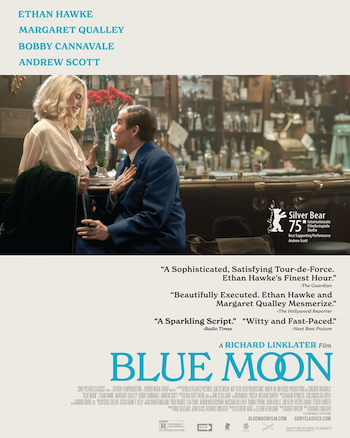
 BLUE MOON is one of Richard Linklater’s two 2025 joints, the one that’s in English and that he didn’t sell to Netflix and that was nominated for two Oscars (actor and original screenplay). At a glance it doesn’t sound like the most typical Linklater picture, because it’s about the songwriter Lorenz Hart when his partner Richard Rodgers has just started a successful new team with Oscar Hammerstein II. But when you see it it turns out it’s very Linklater, because it’s basically a one location play starring Ethan Hawke (like TAPE) and because it’s all about listening to a weirdo carry on and show off blabbing about all the random shit he’s obsessed with (like SLACKER or WAKING LIFE).
It’s basically a bittersweet hangout movie, spending a couple hours at a bar with Hart (Ethan Hawke, 24 HOURS TO LIVE) on March 31, 1943, opening night of Rodgers & Hammerstein’s Oklahoma!. He ruminates on his past, his current failure, his dreams of how to continue, what’s going on with this war in Europe, and many of his opinions about many different things. Also he’s really excited because he thinks he’s in love with a Yale art student he’s been corresponding with who’s going to meet him here. But mostly he just tries to hold court and receive the attention he desires before Rodgers and friends show up to celebrate their triumph without him.
There are a bunch of characters who come in and out of Sardi’s, but two who are there the whole time are the staff – bartender Eddie (Bobby Cannavale, MAXXXINE) and piano player Morty (Jonah Lees, SUPERMAN). Cannavale is outstanding in a role that includes some great banter but that’s even funnier when it’s just reacting, or trying not to react, trying to ignore this guy and do work. Or trying to stop serving him, because he’s supposedly gotten sober, but that’s definitely not sticking tonight. Morty is a soldier on leave and a talented newbie musician greatly honored to meet Hart and play some of his songs for him. At the same time he’s clearly seeing this as the night he might meet Richard Rodgers. He also helps inform us, the audience, when he plays pieces of Rodgers & Hart’s most famous tunes as they try to explain to the flower delivery guy (Giles Surridge) who this is sitting at the bar trying to flirt with him.
 Lorenz talks about his own songs, claims “Blue Moon” isn’t that good, tells stories about what he wanted the lyrics to be but they wouldn’t let him. He talks about what he says are the “best line” in various shows and movies, including CASABLANCA. He pitches ideas for shows he’s convinced are brilliant but thankfully I don’t think we need to agree with him. He’s salty enough to talk shit about the desperation of titles with exclamation points, like Oklahoma!. (This was before AIRPLANE! or EVERYBODY WANTS SOME!!.) He talks about why he walked out of Oklahoma! (or supposedly why) and damns it with faint praise about how huge it’s going to be. He says so many things that made me think, “Yeah, I know this type of dude.” He’s full of shit, he’s obnoxious, but also funny, kinda fun, sometimes correct, I can see why they kinda like him and why they put up with him even though he’s obviously exhausting.
He talks so much shit and then when Rodgers (Andrew Scott, VICTOR FRANKENSTEIN) and Hammerstein (Simon Delaney, THE CONJURING 2) show up he totally kisses their asses about what a work of genius it it is. Congratulations, bravo, all that. He plays the part of the gracious ex-partner proud of his friend’s success, and Rodgers plays along at first but he can see through it, or at least starts to when they’re talking about potentially working together again. Richard seems to genuinely want to make it work, but when he reiterates what he would need (like working normal hours) Lorenz can’t help but toss in some of his little digs, and Richard can’t let all of them slide. He’s already put up with too much in this partnership.
Also he keeps trying to go celebrate with his other friends and Lorenz keeps having one other thing he needs to talk to him about. It’s stressful.
The other major matter of business is that Yale student, Elizabeth Weiland (Margaret Qualley, HONEY DON’T!), who’s not even half his age and also a woman, and therefore not usually his type. But he says he’s “omnisexual” and you can see why he’s enamored of her because she’s Margaret Qualley and she’s a poet and an artist and she talks to him like he’s one of her girlfriends. Gossips about boys, even. Maybe she really doesn’t know his feelings for her, or doesn’t admit it to herself. He once spent a weekend with her and nothing like that happened but he definitely read some things into it that we’re thinking she must not have. Eddie says she just thinks he can help her career. She definitely wants him to introduce her to Richard, and she’s nervous about it.
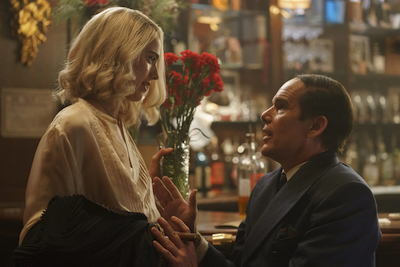 I feel so embarrassed for Lorenz here, but I sort of get it. This would be wrong because of the mentor relationship, and stupid because at only 20 she’s clearly too young to relate to him. But in middle age I understand more why people get delusional shit like that in their heads. I’m not that old, I’m still viable, I’m still relevant, I’m still desirable! Remember when that novelist left his wife ‘cause he thought he was in love with his email friend Natalie Portman, but Natalie wasn’t on the same page? I think it’s normal to have a certain amount of longing for unattainable/incompatible romance – “a dream in my heart,” to quote a famous song – but if you have an ego like that writer or like Lorenz here there’s a danger you’ll decide the fantasy is reality. I feel bad for him. He takes it pretty well though. It’s just one of his illusions about himself that’s being crushed tonight.
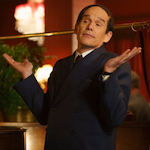
What I really like about this role is that Hawke is taking on a character really different from his typical ones – period, gay, stage musical oriented, combover, also I didn’t mention that they do a bunch of Hobbit-vision type tricks because he’s supposed to be five feet tall – and yet he’s also just that same Ethan Hawke that we love. You know, he starts talking, he gets real passionate, has his collection of clever observations to run through, we’ve seen it in the BEFORE trilogy, in BOYHOOD, in REALITY BITES. It’s like how his TRAINING DAY trainer Denzel played Macbeth and made all the Shakespearean dialogue sound so Denzel, and that’s why it works.
On paper Lorenz Hart is not an Ethan Hawke role. On screen it absolutely is. It’s amazing how well it works. So the Oscar nomination (which is his fifth total, but third for acting, and first in the lead category) is well deserved both for the specific role and for a career that really deserves more accolades (especially since he got snubbed on FIRST REFORMED).
Trivia: The illusions to make Hawke look short were devised by Latham Gaines, his friend and score composer, who’s also an inventor and also played Mesogog, the lead villain of Power Rangers Dino Thunder. Latham’s father Charles invented paintball and narrated PUMPING IRON (based on his book). His sister Greta was the first women’s snowboarding champion.
The also Oscar-nominated script is by Robert Kaplow, author of the novel that became Linklater’s ME AND ORSON WELLES. The credits say the movie is inspired by letters between Hart and Weiland. According to USA Today and Time, Kaplow bought carbon copies of around a dozen letters from a used bookseller (hopefully not one that buys from the CAN YOU EVER FORGIVE ME? lady), but “they suggest more than they say.” Like she’ll “suggest that she and Hart went away for a weekend in Vermont, but she doesn’t actually say what happened.” So he’s filling in the blanks with dramatic license. The true story was probly more mundane.
I’m a little torn on this nomination because for the most part I think it’s well deserved. Screenwriting isn’t only about dialogue, not at all, but one that does so much with so many words is in fact impressive. On the other hand there is one brief little thing – well, a couple different incidents of the same sort of thing – that I found so egregious, so groan-inducing, I was honestly in disbelief that it was put into the script and then people agreed to keep it in the script and then they filmed it and then they left it in the movie and released the movie. See, there’s this gimmick that there’s a guy sitting at a table nearby who Lorenz tries to rope into his conversation, then he realizes he recognizes him from seeing his picture somewhere, then he figures out he’s E.B. White (Patrick Kennedy, WAR HORSE), and he really lights up, talks to him about one of his essays, treats him as a respected peer, tries to impress him and talk shop. That’s all complete fiction and I don’t care, it’s an interesting scenario. The part I object to is when E.B. confesses he’s trying to write a children’s book but he only knows the themes and not the story or characters (how does that work?) and then Lorenz tells him about a mouse he keeps catching in his apartment who he named Stuart. As if that’s not bad enough we even see E.B. write it down in his notebook. Eureka! I don’t know if we’ve seen something that corny in an Oscar nominated film since the Mike Meyers cameo in BOHEMIAN RHAPSODY.
There are a couple smaller characters who we’re meant to realize “oh shit, that’s [famous guy] before he was famous” and the worst one is Elizabeth’s friend who wants to be a director and his name is George Hill and Lorenz advises him to tell stories about friendship. Jesus christ. Jee-zus chee-rist. I couldn’t believe it.
Time described these Gumpian bits as “Easter eggs for savvy students of cultural history.” Kaplow described them to USA Today as “making it a musical fable.” My wife described them to me as “E.B., it’s your cousin, Marvin. You know that mouse you’ve been looking for?” I genuinely question whether this very good screenplay should be barred from awards contention for that handful of misdeeds. I don’t know the answer.
But it certainly didn’t kill the movie for me, it just sours a few minutes of an otherwise good hang. It’s worth it just to watch Hawke go to town, and also I just like seeing this guy excited to talk about stories and words and music. As an artist it’s scary to think about getting to a point where nobody else seems to care anymore about the type of art you want to make. As a human it’s scary to think about getting old and past certain life experiences and possibly running out of time altogether, like he is here. BLUE MOON is sad and clever and beautiful, like some of Hart’s songs. It should be called BLUE MOON! though.



















February 10th, 2026 at 9:53 am
I loved this so much and sat through long stretches of it with a big goofy grin on my face. I would never in a million years have thought of Hawke for this role but he’s spectacular. Both he and Kaplow deserve their nominations, and Hawke deserves to win (although of course he won’t).