"CATCH YOU FUCKERS AT A BAD TIME?"

The Getaway (1972)

Now this is what I call a fuckin MOVIE. I forgot about it until seeing it on Bravo today but it is even better now that I’m older and now that I’ve done my own bid. First though, a word about Bravo. This is the “film and arts network” they CLAIM, but they don’t have the balls to live up to that slogan. You know how Sam Peckinpah movies always have the real slick opening credits with the freeze frames and the atmosphere and what not? They show these in widescreen and your thinking, “Look at that! Look at that rectangular screen! That atmosphere! THIS is a fuckin MOVIE.”

And then it says “directed by Sam Peckinpah” and BAM, no more widescreen. No, that’s just so the words will fit, we don’t need it anymore. The picture is square and cramped and the film is all faded and dark and you’re thinkin, “What is this crap, Hunter?”
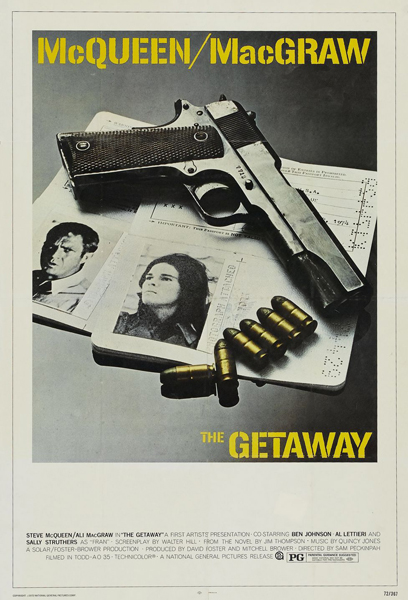
The GetawayBut worse, at the end of the movie, the credits come up and BLOOOOOP, the screen shrinks down to unreadable size and the rest of the screen is giving trivia about Carter Burwell. And I’m sure I’d like that dude as much as the next guy if I knew what movies he was in but jesus man, this is the film and arts network, you gotta understand some of us Cinema appreciaters such as myself and some of these other motherfuckers, they want to read the damn credits.

Anyway the Getaway. This is the story of Steve McQueen as Doc McCoy, an armed robber who just got out of the joint. Which I think alot of us can relate to. Doc goes on a job that goes a little sour. For one thing, his partner Rudy tries to kill him. So he and his wife Ali McGraw take the money and run for the Mexican border. Along the way they have to deal with cops, Rudy and others chasing after them. And they have a lot of problems and they go through alot of cars and at one point some fucking pickpocket scum even swipes their bag at the train station. What a pain in the ass.

There are alot of movies with this type of story but this is the more Artistic kind where the directorial techniquery elevates it to an epic. It is also important to note that Steve McQueen is one of the best Badasses of all time. I don’t think I need to tell some of you but you young kids, you gotta realize this is a bad motherfucker. This is the guy I would’ve wanted to play me in a movie. We don’t have many left of this school of Badass, I think Clint may be the only one left who’s doing lead roles. I’m not talking about these wisecracking pretty boys we have now, I’m talking about the quiet older guys with the wrinkled foreheads, the guys with the narrow eyes, maybe a few scars. Guys like Steve, Clint, Chuck Connors, maybe throw in Charles Bronson, who has a good mustache by the way. Steve is clean shaven but whatever happened to mustaches in Badass films, man? The Getaway is Texas in the ’70s so there are alot of supporting mustaches in this one and I feel that is important to the success of the picture.

But the real reason why The Getaway is so great is because of the director Mr. Sam Peckinpah who has an undeniable sense for the filmatic language as well as this guy is a poet. And by poet I mean a guy who drinks alot and can’t help but have all of his problems and attitudes pour onto his works even if they are a for-hire job like this one. I do not mean he rhymes, there are no rhymes in this picture as far as I noticed although I will pay attention to that if I see it again.

Now this is gonna be a controversial statement, but hear me out. I have a theory that Sam Peckinpah, he had a problem with women. The ladies in his pictures are always terrorized. They get hit, they get raped, they cry alot. In The Getaway, this slob Rudy takes a couple hostage and the wife instantly falls for Rudy. The husband soon hangs himself (Peckinpah hates wimps) and the wife doesn’t seem to even notice, but she cries hysterically for Rudy.

Still, I think Peckinpah is at least trying to treat a woman right, and this movie is really about a relationship in my opinion and maybe should be called The Relationship not The Getaway. Ali McGraw gets Doc out of the can by sleeping with a fat dude on the parole board. In exchange Doc has to help out with a job, and this parole fuck also makes a deal with Ali to turn on Doc. She chooses Doc and kills the parole dude but the jealousy lingers.

Even before that, though, there is tension in the relationship. As Ali takes her shirt off the day Doc gets out, Doc doesn’t know what to do. He says, “It does somethin to ya. It does somethin to ya. It does somethin to ya in there.”

As they face more problems in their run for the border, they seem to get farther apart. You know they’re gonna get back together by the end but hell man, I think it works because it seems honest. I don’t think Doc is the best husband for Ali to be frankly honest, but the story is still touching in my opinion because Peckinpah means it.

That’s cause this Peckinpah really was all about contradictions and what not. He knew he was a true Artist but he worked for hire and called himself a whore. He said he hated battling with executives but he couldn’t stop doing it. And he had a spectacular talent for filming violence, but seemed to be appalled by the whole idea of it. The Wild Bunch was meant to be so gruesome that it would show violence for its ugly self. The Getaway isn’t the same type of picture but it follows on those themes – practically every gunfight has several shots of innocent little kids peeking around corners to watch. When Rudy jumps out of a car, a kid pokes at his body, and when Doc is on a train a kid threatens him with a squirt gun.

What I like best about the Peckinpah pictures though is not only the feel, but the little touches that you haven’t seen in another movie. Like when Rudy is flirting with the wife by throwing barbecued ribs at her in the car. They’re all giggling and throwing ribs at each other and the husband is driving and he can barely stand it. And eventually Rudy starts to lose the rib fight and even though he started it he gets pissed and starts yelling. What a fucking baby. And that is really the type of dude you deal with half the time in this business, in my opinion.

But my favorite scene in the movie, like in many Badass pictures, is just one of those Badass touches where the Badass does something so god damned Badass you can’t believe it. In this one, Doc leaves Ali in the car and walks into a store: “I need a radio, portable.” Doc starts to walk away without collecting his change just as the clerk turns and sees a sketch of Doc on all the TVs in the store.

But Doc doesn’t panic, or even run. He leans into the car, says, “We got trouble, you better clear out the car,” walks directly into a gunshop next door and says, “I need a shotgun.” And THAT type of thing is what this movie, and all Peckinpah movies, is about. Plus relationships.

This entry was posted on Wednesday, January 1st, 2003 at 12:41 pm and is filed under Action, Crime, Reviews, Thriller. You can follow any responses to this entry through the RSS 2.0 feed. You can skip to the end and leave a response. Pinging is currently not allowed.

19 Responses to “The Getaway (1972)”

  1. Damn! I purchased BULLIT on Blu-ray today ( hey,that rhimes!) and it made me think of this bad motherfucker of a movie. Í taped it when it was on swedish tv and watched it a bunch of times. It has some of the best shotgun-sequences I´ve seen ( A BETTER TOMORROW 2 is another ,maybe because it´s Woo and he also likes slow-mo shotgun-scenes) . McQueen is tearing up a police car with a shottie in broad daylight. man, that IS bad-ass ,meanwhile that whole hostage subplot was real nasty and fucked up. If I ermember right, the remake didn´t wuss out on this part and included the same shit. Man, this movie has balls the size of Texas.( I myself has never been to Texas, but it seems to be a pretty large place). I´d also like to mention that the guy playing Rudi is Al Lettieri from MR MAJESTYK. Now you know, you need to watch this fucker. Damn!

  2. The relationship angle goes even deeper and is better developed in the original novel by Jim Thompson, who also wrote the original script and included the El Rey ending in it. Unfortunately, McQueen considered it a downer (and it was, which was sort of the point) and it was removed when Walter Hill rewrote it. I highly suggest tracking it down.

    If nothing else I feel like it also gives a bit of added heft to From Dusk ‘Til Dawn where Tarantino also uses El Rey as the Mexican hideaway that the Gecko Brothers are fleeing to. Presumably it was just a name drop rather than a direct allusion to his future, but sometimes it’s fun to imagine that it turns out roughly the same way. Except with vampires and foot fetishim.

  3. So I’m making my way through Tarantino’s book of film criticism (Capsule review: Readable but underwhelming, both in film choice and level of insight. Tarantino chooses to do a whole chapter on well-trod terrain like DELIVERANCE or DIRTY HARRY, you figure he’s gonna have some crazy new angle on them. Nope. Same old shit. Kind of a letdown.) and there’s only a dozen or so movies in it, so I figured I’d watch them after I read the reviews. I’ve seen and/or own almost all of them anyway and this is a good excuse to revisit movies I haven’t seen in a while, many of which I didn’t particularly respond to the first time around.

    This one’s in there, along with BULLITT. And at this point I got no choice but to admit that Steve McQueen just isn’t going to grow on me like I’d hoped. He’s kind of funny as an upstaging little peckerhead fiddling with his hat in the background of THE MAGNIFICENT SEVEN, and who doesn’t like THE BLOB? It’s in the Criterion Collection, for God’s sake. An American classic. But other than that I just find him the most uninteresting movie star of all time. He’s supposed to be so laconic and cool, but he just comes off sullen and boring. He’s supposed to have this quiet mystique, but it’s all surface. He does inspire me to ponder what depths lie beneath his unflappable exterior. I knew a lot of these men-of-few-words growing up. They weren’t the strong, silent type, they were just angry alcoholics who never bothered to develop a personality. I look at Steve McQueen and I see the guy those guys think they are, and McQueen’s not pulling it off any better than they are. He just looks slightly cooler in a turtleneck.

    As for this movie, it’s certainly got some great sequences. The shotgun purchasing Vern mentions, the opening credits montage, the whole finale. But the McQueen problem extends to the whole cast. Every character is a classic crime story archetype, but they’re all the dullest possible version of it. The calm, cool professional’s a bitter, aggrieved void, his ride-or-die’s a dipshit for staying with him, and even the mad dog killer is fuckin’ snooze. About the only one who brings any life to her character is Sally Struthers as the bimbo crime groupie. So what we’re dealing with here is a love story between an asshole and an idiot as they’re pursued by a loser. And it’s a half hour too
    long. Not exactly a gripping thrill ride nor an engaging character study.

    In fairness, I’m not the world’s biggest Peckinpah fan either. He can shoot a guy getting blown away like a goddamn poet, but all his characters are Steve McQueens. Boring, aggrieved dudes who blame the world for not letting them conquer it. I know these dudes and they’re the least interesting people in existence. I am not entertained or enlightened watching them slap their old ladies around and drink themselves to death. I know everything I need to know about that type of dude. We all do. They’ve held us hostage since the dawn of time.

    Oh well. At least I got to watch DIRTY HARRY again.

  4. EDIT: He *doesn’t* inspire me to ponder his depths.

  5. I don’t remember a ton of Tarantino’s book but I do remember he seemed morally betrayed that this move didn’t include the character whose head was badly damaged by his delivery doctor’s forceps, like that wouldn’t have turned this into a Robert Z’Dar movie. At least in the book, he was less prone to have disagreements with the way other directors handled their movies than he was to think those guys pussed out, threw their auteur cards into pee puddles and then spit in his eye.

  6. I think he comes off less confrontational than that. He’s aware of all the reasons the movie is less hardcore than the book (Steve McQueen needed a hit) but honest about what he thinks doesn’t work. He admits that the book’s ending would never fly in a movie, and certainly not that movie.

    The only time he really gets up on his high horse is when he dismisses the entirety of 80s cinema, which he assumes isn’t littered with gritty 70s unhappy endings solely because everyone involved was a sellout pussy conformist, unlike himself, the purest, most uncompromised filmmaker who ever walked the earth. Pure adolescent edgelordery, like dudes in their forties who can’t stop ranting about a band they hated in high school. Get over it, man.

  7. You’re probably right. I may be remembering a general sense of his tone, rather than the tone of the Getaway chapter. The Hardcore piece all but calls Schrader a sellout for the way that movie ends.

  8. The thing we probably no longer grasp about those early postwar macho guys like Steve McQueen, Sean Connery, the Rat Pack, Hugh Hefner, early Jack Nicholson, etc. is that for their time they may have represented a then-new type of liberated masculine cool that was not tied to family life or other obligations – an aesthetic that hasn’t necessarily aged well.

    Re: “Boring, aggrieved dudes who blame the world for not letting them conquer it. I know these dudes and they’re the least interesting people in existence. I am not entertained or enlightened watching them slap their old ladies around and drink themselves to death. I know everything I need to know about that type of dude. We all do. They’ve held us hostage since the dawn of time.” – Maj, that sums up my feelings about the cult of 1970s New Hollywood and their decades-long resentment at not being the flavor of the month anymore.

    Those movies are good, but I will always resist the idea that movies about men yelling (and women crying because their men are yelling) are the best and only form that True Cinema can ever take. Fans of that movement are always mad that any alternatives to it exist.

    Hatred/dismissal of 1980s cinema is always a huge red flag to me. It’s always the sign of a rage-filled male of boomer age or older who thinks that imagination, humor, or anything else that might appeal to women and/or young people is an absolute crime against the natural order of things.

    Several of Tarantino’s hot takes in that book went viral as soon as it was published, but the one that really stunned me was his criticism of Bill Murray becoming a better person at the end of GROUNDHOG DAY. That’s not a copout ending, it’s literally the point of the entire story, as even a casual fan of that movie could easily point out.

    OK, Tarantino likes violence and violent characters, that’s not news. But his book-length insistence that this is what movies are for, and any other approach is a sissy dishonest compromise, is a reminder that a good rule of thumb to be a decent, moral, emotionally balanced person is perhaps to look at how men of the 1970s live their lives and then do the opposite.

    Having said that, it was interesting to learn from the book how his formative early experiences seeing exploitation films with vocal audiences shaped his desire to both manipulate and wrongfoot the audience with his own movies.

  9. I think his point about Bill Murray is less about GROUNDHOG DAY specifically and more about Bill Murray’s filmography in general. Bill Murray’s whole deal is that he’s an entertaining asshole, so why do the plots of so many of his movies work so hard to make him stop being the thing the audience is paying to be entertained by?

    GROUNDHOG DAY, obviously, is the wrong movie to use to make this point, because what could even happen in GROUNDHOG DAY if he’s not working toward self-improvement? He just stays a selfish cock robbing banks and scamming broads for eternity? What kind of a story is that?

    Now, a SCROOGED where he resolutely refuses to learn the true meaning of Christmas and just goes on being a prick, that could have really been something.

  10. All of this stuff about New Hollywood is actually why Five Easy Pieces is one of my favorite movies– Jack Nicholson plays a liberated dude who can’t be tied down and doesn’t want to live the life his family expected him to, but he just seems like an asshole squandering his life and condescending to people, totally damned. Maybe not a coincidence the movie was written by a woman, from a story she developed with the film’s director.

    I would also completely understand if a person felt Five Easy Pieces was just another movie about an aggrieved dude who yells at people and will drink himself to death. I don’t think the film has much sympathy for him, which, to me, turns it into the opposite of one of those macho movies, or at least makes it a movie about how that macho outlook has failed a person.

    Not a movie about 70s movies, but Listen Up, Philip is a great antidote to that attitude. Young writer tries to be more like his Philip Roth-y idol and winds up kicking himself in the dick.

  11. QT’s disdain for 80’s cinema is strange. I mean, it’s not like his movies are in any way truly channeling the gritty, downbeat and nihilistic tone of those “uncompromised, pure, non-pussified” films he adores. They all have “happy” endings in some form or another.

    Sure, Buscemi’s the only one to make it out of the warehouse at the end of DOGS, but was anyone rooting for Keitel and Roth to walk off free to continue their Bromance?

    Everyone (main characters that is) in FICTION got a happy ending except maybe Vincent, but he was about to kill Butch, a far more likeable and less morally compromised character.

    JACKIE BROWN gets a happy ending

    The Bride completes her Roaring Rampage of Revenge and is re-united with her daughter at the end of KILL BILL

    Stuntman Mike gets the shit kicked out of him in DEATHPROOF

    DJANGO rides off into the sunset with his Lady Love, a free man

    I guess you could make a case for Jackson and Goggins bleeding out in bed at the end of THE HATEFUL EIGHT as a downer, but all the truly evil people have been dispatched, the mystery is solved and these guys have made their peace with each other and their impending end.

    And QT rewrote history-TWICE!- to give a happy ending where none existed in real life.

    So, he may love his 70s, but his films generally channel a far more optimistic vibe, which I tend to associate with the 80s.

  12. Spoiler alert [x9]

  13. What! There’re people around these parts who HAVEN’T devoured the entire QT filmography at least 12 times??? Shocker!

  14. “Bill Murray’s whole deal is that he’s an entertaining asshole, so why do the plots of so many of his movies work so hard to make him stop being the thing the audience is paying to be entertained by?”

    This also tracks with what QT mentioned during the Joe Rogan podcast that he’s not too fond of the Redemption Arc in a Bill Murray movie and prefers Chevy Chase cause his films don’t play that shit. Chase remains the same unrepentant asshole at the end as he was at the start, which is interesting given Chase’s well documented history of being a mean, toxic asshole to all his co-stars and co-workers.

    That recent documentary on him is something, he’s even a dick to the very film maker interviewing him!

  15. As always you make some fascinating points, Majestyk.

    I don’t mind McQueen, while not exactly being his biggest fan.

    Thing is, unlike say, a Paul Newman, whose calm, laid back demeanor (especially the Newman of COOL HAND LUKE, BUTCH CASSIDY & HOMBRE) seems unforced, McQueen’s own cool, unflappable persona seems to mask some seething anger just bubbling beneath the surface.

    I’ve read the QT book as well, and one of his best points in his appraisal of BULLITT is that the character is who McQueen probably wishes he was, the guy who never reacts or loses his shit even when everyone around him is.

    As for THE GETAWAY, I prefer the Roger Donaldson remake (better action, a cool Alex Baldwin, smoking hot Kim Bassinger and the late, great Michael Madsen oozing reptilian menace with only Jennifer Tilly’s screechy bimbo not quite working for me).

    This one just didn’t so it for me and seen today, some scenes are uncomfortable even for a “Mr Separate Art From Artist” like me. When Doc discovers his wife slept with another man to secure his release, he hits her repeatedly, which given that in real-life, McQueen’s volatile persona often led to physical violence being visited on his partners, one of whom was McGraw, this one hits an especially sour note.

  16. I read his book but I was trying to watch Tarantino’s big influences (Things To Do In Denver When You’re Dead, Albino Alligator, the first three quarters of Four Rooms, etc.) before watching any of his cinema. This spoiler betrayal has me feeling like how Oldboy felt when he found out he’d fallen in love with his daughter and then cut his own tongue out in the final moments of Oldboy.

  17. But in terms of betrayal though…. doesn’t the chick in THE CRYING GAME turning out to be a dude sting harder?

  18. That’s another thing the 1970s film bros were always very fixated on – the knee-jerk equations of “downer ending = pure artistic truth” and “satisfying ending = soulless corporate sellout” (see also Robert Altman’s SHORT CUTS). Anger and frustration are real, any other human emotion is phony.

    And I’m sure those movies are critiquing their toxic-masculinity protagonists at least as much as sympathizing with them… but the fact that those filmmakers and actors seldom seemed to have it in them to explore any POV other than just that one always seemed like a revealing bias.

    I think part of that is generational. Those of us who grew up in a world of home video options (rental stores, specialty cable TV channels, streaming etc) understand that there are multiple genres, styles, tones, and eras, to appeal to multiple audiences or even just different moods. Whereas that earlier generation has always seemed very focused on policing and gatekeeping to enforce a particular style or era at the expense of any others.

    I say screw that. If I want to, I can watch BETTER OFF DEAD today and DOGVILLE tomorrow (and I just might).

  19. I think I’ve led to an oversimplification of Tarantino’s complaints. It wasn’t just the unhappy ending thing. He was more focused on the idea that all protagonists in the 80s had to be “likable” or at least “relatable,” which is something filmmakers still complain about to this day. He’s not entirely wrong. As we’ve discussed at length on this thread, the 70s were packed with movies about total pieces of shit. You milage on the value of that may vary, but it’s indisputable that, freed from the standard film protagonist’s rigid morality, those characters could behave in unexpected ways, allowing the movies to be more unpredictable than they would be in the following or preceding decades. Now, I think it’s fair to criticize his whole “I only like chocolate cake therefore all cakes must be chocolate” school of thought. These 70s movies about complicated assholes whose stories end badly must have seemed like a welcome novelty when they were new and fresh, but as the decade wore on, it must have gotten wearying. There was a reason STAR WARS caught on so huge, and it’s because people were hungry for the traditional mode of storytelling. The 70s being an outlier in film history is what makes that era interesting. If traditional storytelling didn’t come back as the predominant mode in the 80s, Tarantino would have had nothing to subvert in the 90s. Both modes have value. When either of them dominates for too long, it just makes the pendulum swing the other way that much harder.

Leave a Reply


XHTML: You can use: <a href="" title=""> <abbr title=""> <acronym title=""> <b> <blockquote cite=""> <cite> <code> <del datetime=""> <em> <i> <q cite=""> <s> <strike> <strong>