 I loved the first two films from writer/director Julia Ducournau – RAW (2016) and TITANE (2021) – so of course I went to see her new one, ALPHA. I know it didn’t go over well when it played Cannes last year, and I sort of get that because I felt I didn’t connect with it as much as I did the other two, I didn’t understand it as much. But it’s a special movie. Ducournau paints sickly portraits of a world where flesh is malleable, pain is universal, behavior is extreme, and so is emotion. Any chance to spend two hours seeing through her eyes is a rare cinematic buzz, and as I go back over ALPHA to write about it I’m making new discoveries, it’s sinking in deeper. I urge all Ducournaunauts not to skip it.
I love her matter-of-fact presentation of the bizarre – a sort of magical realism but with weird shit instead of magic. In RAW she had such a persuasive depiction of savage hazing in a veterinarian school that I felt like I should look up if this was a real phenomenon. ALPHA starts with a character seeming to get off on stabbing himself with a tattoo needle, followed by our thirteen year old title protagonist (Mélissa Boros) getting the letter ‘A’ carved into her arm while drunk at a party, so at first I thought we were in for some body modification subcultures. But actually I remember my friends cutting the Dead Kennedys symbol into their arms in middle school, so this is not really science fiction. (I don’t recommend doing that. Good band, though.)
Alpha doesn’t think it’s a big deal, but her mom (Golshifteh Farahani, EXTRACTION II) is a doctor, so she asks about the needle, disinfects the cuts, makes her get a blood test in two weeks, to make sure she didn’t get “the virus,” but she’s not talking about the one we might assume. We see Alpha’s mom working at the hospital, where most of the staff has left, and only she and a less dedicated nurse (Emma Mackey, ELLA McCAY) are left to watch a full ward of patients dying from a strange plague. The disease gives them protruding blue veins and yellow bruises and turns their skin to marble. It can even chip off. Sometimes they cough clouds of chalky dust, you can hear it rattling around in their lungs.
 The marble skin (which I find both disturbing and beautiful) is the most fantastical thing in this world, but everything in it is expressionistic. Ducournau is less interested in the literal than in how things feel for her characters, so the sky is always drearily overcast during daylight, and at night there are often scary windstorms that seem to be a manifestation of Alpha’s panic attacks. It’s a story where many scenes seem like they must be dreams and then they just keep going and never necessarily reveal themselves to be.
The apartment is surrounded by red dust, which turns out to be meaningful. I can’t remember if we ever see any grass. The school is decrepit, dimly lit, it has a very small restroom covered in graffiti where Alpha goes to clumsily make out with her friend Adrien (Louai El Amrousy). He genuinely seems to care about her, he’s nicer to her than all the other kids, but he has a girlfriend, so that’s not cool. Also the girlfriend is Alpha’s primary bully. Alpha has at least one teacher (Finnegan Oldfield, INFESTED) who seems sympathetic to her misery, but he himself gets bullied for being gay.
This movie is full of specific things that make me queasy: shooting up, cutting, veins, convulsing, bleeding. Alpha’s wound keeps re-opening, causing embarrassment for her and panic for her schoolmates. She bleeds on the overhead projector in English class, on the volleyball in P.E., in the swimming pool (but that’s from that bitch banging her head against the side). She gets pretty casual about having blood on her.
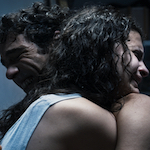
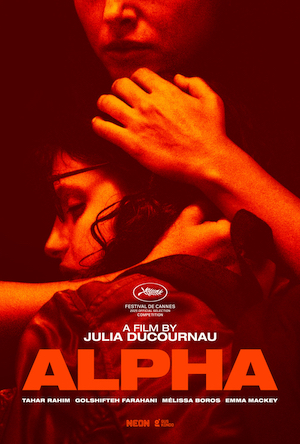
In terms of violence it’s much tamer than RAW and especially TITANE, not even exactly a horror movie, except for the body horror of the virus. It’s a drama, and I can prove it: most of the posters and publicity stills feature family members hugging. Just like Ducournau’s other films, whatever repulsive or upsetting material may be there is balanced by the film’s radical empathy, its refusal to judge.
In large part it’s about Alpha’s relationship with her uncle Amin (Tahar Rahim, INSIDE, A PROPHET, MADAME WEB). She’s terrified one day when she comes home from school and he’s sleeping in her room. He says he babysat her once, but she doesn’t remember him, and he’s clearly a junkie. Skinny, shaky, itchy. This is a classic Ducournau character because at first he seems like the skeeviest cinematic uncle since Frank in HELLRAISER, but by the end I really cared about him, even as his addiction and self destructiveness put young Alpha in danger.
There’s an aspect of the movie I feel I should warn about, because that might’ve helped me. Maybe it’s just me, but I was very slow in realizing that it’s switching between two timelines. There’s a visual cue that when Mom’s hair is curly it’s in the past, but come on – some people curl their hair. I didn’t know! It wasn’t until the scene where she says her daughter is five that I started to understand the structure. Some of the disorientation is definitely intended, and it ultimately pays off in an unusual way. Technically it’s a plot twist, but it’s more of a poetic device than a gimmick, and once I figured it out it revealed the meaning of some earlier events. I’m sure I’ll understand it better if I ever watch it again.
In both the present and the past, Amin struggles with heroin addiction. He also gets the virus. We meet he and his sister’s extended family, have dinner with them. They’re proud of their Berber language and traditions, they joke and laugh and bicker, their grandma believes in old country folk magic type stuff, but none of them seem to look after Amin like Alpha’s mom does. She’s always the one there trying to stop him from killing himself, on accident or on purpose. She’s the one who literally revives him. But now it’s Alpha who’s spending the most time with him cooped up in their apartment. He becomes a little bit of the cool uncle that understands you but also the scary uncle who is reckless with you. He brings her to some crazy bars, I’ll tell you that.
All three of the leads are outstanding. It’s two accomplished actors digging into new facets of their abilities, and one young newbie somehow holding her own, her sad face filling the screen, conveying so much about trying to survive in a world she’s not ready for. “I’m too young,” she keeps saying, and it applies to so many things.
Trauma and grief are two major topics of ALPHA. I know it sounds stupid to say that about a movie at this point. Maybe we don’t even need to categorize all its emotions with simple words like that. It’s about the mom’s painful love for her troubled brother, all she went through for him, why she needs to let go, how it affects her daughter, both through her own vague memories from when she was very young and second hand. And I’m sure it’s about other things, but these are what came across to me, especially in the beautifully haunting ending.
When I came out of the theater I figured that being the third best Ducournau movie was still way better than most movies. But a day later I thought maybe I’d been underselling it. It didn’t occur to me while watching, but of course this is a personal story for the director, who does have Berber heritage, and whose parents are doctors. I thought it might be set in the ‘90s, because I noticed Tupac and Nas posters in Alpha’s bedroom, and that could put it at when Ducournau was Alpha’s age. In interviews I’ve seen no mentions of whether she had a relative who died of AIDS, or whether any scenes (like the opening one involving a ladybug) came from childhood memories, but whether these are things that come directly from her life or not, they feel deep and true. Yeah, ALPHA is growing on me.