


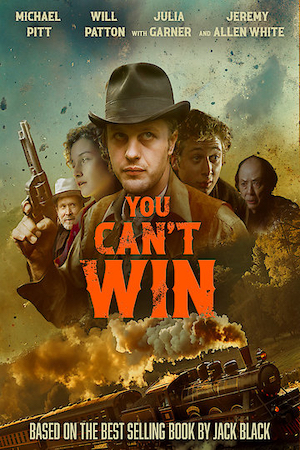
I watched a curious new movie that nobody else seems to know about. Just came out on DVD yesterday, no fanfare whatsoever, and I couldn’t find any reviews or even promo photos of it. It says “based on the bestselling book by Jack Black,” but I don’t think it’s trying to trick us into thinking that’s the same Jack Black from I STILL KNOW WHAT YOU DID LAST SUMMER. This one spent his life riding the rails and stealing, and then he wrote a memoir about it that was published by Macmillan in 1926. I admit that I never heard of it before, but it seems it was a sensation in its time and it’s stayed enough of a cult book that it was reprinted by Amok Press. Apparently William S. Burroughs read it when he was a kid and cited it as an inspiration. (This was before Encyclopedia Brown.)
That seems like a book I should read, but more relevant for this moment it sounds like good source material for a potentially interesting movie. And what really sold me on it is that it’s directed by Robinson Devor, whose debut was the excellent Charles Willeford adaptation THE WOMAN CHASER. He also did the documentary ZOO that some of you might remember me reviewing for The Ain’t It Cool News.
YOU CAN’T WIN is kind of like an evil cousin to TRAIN DREAMS. It’s another hazy, non-linear contemplation of a quiet, simple man’s life in the late 1800s and early 1900s. Both were filmed and partially set in Washington state, and IMDb says they share nine crew members, plus Will Patton (THE POSTMAN), who appears on screen this time, he’s not the narrator. Both movies include problematic encounters with Chinese immigrants (this guy gets caught trying to steal from James Hong). But while Mr. Train Dreams spent his life working what was considered an honest job and yearning to be home with his family, this Jack Black does nothing but crimes for most of his life, always riding the rails, never sticking in one place except when he gets locked up. He does have a girlfriend at one point, he finds her on a river bank crying, she seems like an interesting character who says her name is Annie but implies that’s not her real name. I believe they stick together for a while, but whether that can be measured in weeks or years I couldn’t tell you, because those sorts of things are never made very clear in this movie.
It sort of tells us how he got started. His dad (Ted Rooney, SANTA PAWS 2: THE SANTA PUPS) was shell shocked or something so he was kinda left on his own and the adults he’s around help him get jobs. First it’s stand here and knock on the wall if you see a cop out the window, then it’s stand here while I sneak into that house. He gets arrested real young and in jail one of the big shots he meets is Foot and a Half George (Patton), who gives him inspirational words about the underworld being a brotherhood that he might be able to be a part of. Years later when he’s grown and played by Michael Pitt (SEVEN PSYCHOPATHS, DETECTIVE CHINATOWN 2) he’s excited to cross paths with George again and be remembered.
 There are many movies where the style is not to explain what’s going on all the time, you just get dropped in to go with the flow and enough of it will come together if you keep watching. Maybe I’m slow but for me each scene would feel understandable enough on its own but then the next one would generally be an indeterminate time later with a different set of people and situations and I’d feel like I was at the bottom of a hill unable to climb up. He starts working with I believe a fence named Salt Chunk Mary (Rusty Schwimmer, LOS LOCOS: POSSE RIDES AGAIN), who gives him a very intimidating speech about what his role is, and he says “Yes ma’am.” And then there’s another very memorable scene much later in life, he’s down on his luck and finds her and she very forcefully refuses to acknowledge that she’s the person he used to know. The first and last meetings made strong impressions, I don’t remember anything in between.
If the book is an Iceberg Slim kind of deal where it’s fascinating just to see the detail and perspective of a criminal, then that could probly translate into a couple different types of procedurals. Maybe the GOODFELLAS type where there’s lots of narration directly explaining it to us, or maybe a THIEF type where we sit back and watch them do their thing. This is closer to the second one, but it’s not very technically minded, and it seems determined to test my belief, last mentioned in my review of THE MASTERMIND, that it’s interesting to watch the mundane details of a crime. The one aspect of criminal activity that they illuminate in a novel way is the idea of burglary as very slow, very careful creeping and sneaking. It’s never the excitement of storming into a place. It’s more about very slowly progressing up the creaky wooden stairs like you’re a damn Butoh dancer so the owner doesn’t wake up.
Even when you get caught, in this depiction, it doesn’t become a thrilling action scene. There’s just a sudden gunshot out of nowhere and it’s over.
Maybe the best and most exciting scene is the one where Jack is trying to steal something stashed under a sleeping man’s pillow. He has his hand under there, moving ever so gradually. And the guy keeps making noises like he might wake up, even rolls over the other way and opens his eyes… maybe he heard him? But his wife tells him to go back to sleep. When he turns back the other way again he practically touches noses with our guy, he might feel his breath… It’s so drawn out and gets tenser and tenser and then, diabolically, the scene ends without letting us see Jack yank the thing, or even know if he got it. He survived the encounter, is all we really know.
I think that signals that this is Devor’s intent: the deliberate withholding of pay offs, or of explanations, or of details, or many other things. We barely get to know any of the characters, and I would include Jack in that. We don’t hear his thoughts on many things, we don’t see him do much outside of crime, we don’t even really have that much of an idea how good he is at crime. We see him in prison more than once, and the opening titles tell us he spent most of his life there, which I would not have guessed from the movie. We generally don’t know what he’s in for and never know how long he stays.
One thing we do really understand is the code of silence. Pretty much his first lesson is the importance of not saying anything when he gets caught. It’s practical advice to not self-incriminate, and moral advice to not snitch. The reason George respects him is that he was a kid who didn’t say a word to the cops. So it’s a great irony that the whole reason we’re watching a movie about him is that he spilled their secrets to the whole fuckin world in a book. How he came to be willing to do that, or how he felt about it, or how any surviving associates might’ve felt about it… those things are not really explored. There is a good scene of him doing a reading in front of a bunch of rich people, who are loving it. And it’s good. You hear him putting his methods into words and you think damn, I wish the movie was like that.
I think YOU CAN’T WIN was a passion project for Pitt, who is a producer and also co-writer. He gets an “and” credit after Devor & Charles Mudede (a Seattle writer/critic/character who also wrote ZOO). IMDb also lists the novelist Barry Gifford (PERDITA DURANGO, WILD AT HEART).
Pitt’s Jack kept reminding me of a Boyd Holbrook character, minus the humor. Other times I felt like he has the sad, tired eyes of modern DiCaprio. He gets to play different ages, mustaches and levels of wear and tear and an emotional moment where he knocks on some lady’s door holding a gun and says he’s gonna shoot himself if he doesn’t kick this drug habit. Did I feel we were building to something like this? No. Did I even realize that the one or two parts earlier where he smoked opium meant he was having an increasing addiction problem? Also no. Was he great in this moment though? Yeah, I think he was. Too bad so much of this treats him less like a person than a re-enactment of an enigmatic scowl from a rotting daguerreotype. The story is not told in a way that prioritizes things like what he’s thinking, what his personality is, conversations that he has, etc.
I suspect it was a conscious choice to tell the story this way, to sort of paint some shapes on the periphery to imply the story in between. They may have been successful at what they were trying to do, but if so it’s coincidentally pretty much the same thing they might’ve ended up with if they ran out of funds before shooting some important scenes and did their best to edit it into something that made sense.
I’m not saying that is what happened, but I do wonder, because of the following: Jeremy Allen White (FREMONT) and Julia Garner (THE ASSISTANT) both get “with” credits and headshots on the cover. Those are two actors I think are always great, and I figured they would be small roles, but these are definitely “at the time we didn’t know they were going to be huge actors” type of roles. White plays an early, brief mentor to young Jack and Garner plays a prostitute he talks to one time. Both are visibly much younger than we know they are now, and Garner’s voice is so high I was convinced she was still a teenager when they shot this. But I looked her up and she’s 32, so that’s not— I’m sure it’s a few years ago, but it couldn’t—
Oh, shit. Actually check out the date on this article in a Port Townsend newspaper about them filming in town. It’s from 2012! So this might’ve shot before WE ARE WHAT WE ARE. They probly knew Garner from MARTHA MARCY MAY MARLENE, which Louisa Krause, who plays Annie, was also in.
Okay, yeah, I gotta assume this was a troubled production that has only now escaped from limbo, thus the unceremonious release. I guess it was more fun to figure that out on my own than to know it going in.
I think there’s an interesting theme here that in a way Jack just did what everybody’s supposed to do: he found himself a trade, he learned a code to live by, he worked hard to survive during tough times. It just happens that the society he fell into was an illegal one, and when we see some of the things that the legal one does – such as beating and torturing him in prison – it’s not clear that one is better or worse than the other.
And it’s a good looking movie, it has a good period feel, doesn’t feel as low budget as it apparently is. I stuck with it patiently but ultimately felt like I had been led down a trail to nowhere. Well, less of a trail than a portal that warps to a totally different place where he has become a successful writer, wears nice clothes and really, really loves being a guy who smokes a big pipe all the time. I mean he got so into being a pipe guy he probly never missed crime one time.
I’m sorry to go so long picking apart a movie that you most likely would have never heard of. Maybe I should’ve followed the code and kept my mouth shut. But I sincerely hope whoever else ends up finding it thinks I’m an idiot and this really does it for them. I’m still interested in these filmmakers, and possibly even in becoming a hobo if the book is better than the movie.




























February 18th, 2026 at 2:29 pm
I have the book. It’s pretty good; it’s kind of a Depression memoir (though it predates the Depression) – I would file it alongside Harry Crews’ A CHILDHOOD, Tom Kromer’s WAITING FOR NOTHING, and James M. Cain’s THE POSTMAN ALWAYS RINGS TWICE. They all have that same “life is shit, grab what you can” feeling. Don’t know if I need to see the movie – I tried watching BOARDWALK EMPIRE and Pitt was just a blank space in the middle of the screen.