
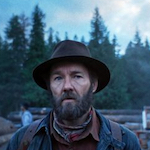
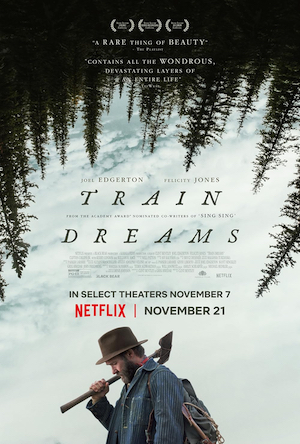
 TRAIN DREAMS is the chillest and maybe artiest of this year’s best picture nominees. It was also nominated for best adapted screenplay (from the 2011 novella by Denis Johnson), best cinematography (Adolpho Veloso) and best original song (Nick Cave). If you never heard of it, it’s because it’s only on Netflix, and because it’s a peaceful, contemplative movie about the unremarkable life of a logger in Idaho. There’s a bit of THE TREE OF LIFE in it, but it’s not as slow or humorless as that might sound. I liked it in more than a “pretty good for homework” type of way.
It tells the story of Robert Grainier (the Master Gardener himself Joel Edgerton), who grows up an orphan in and around Bonners Ferry, Idaho, and doesn’t have much passion for anything until he meets Gladys (Felicity Jones, THE TEMPEST). They get married, buy an acre of land next to a river, build a cabin, have a daughter. He gets some work helping build a bridge for the Spokane International Railway but has a bad experience, then spends most of his life doing seasonal logging work, away from where he wants to be, and worrying he’s cursed.
A narrator (Will Patton, THE POSTMAN) introduces us to Robert by summing up his existence from the distance of a historical bio: he lived between these years, mostly in this town, traveling this many miles in these directions. A perfectly logical way to summarize the life of somebody you never met, but never how anybody could see themselves.
 That idea of stepping back to see life from a different angle keeps coming back. When the crew finishes building their bridge an executive for the railroad lauds them for saving the trains 11 miles of travel around a gorge, which sounds great! Then it immediately cuts to Robert much older, riding a train on a bigger bridge looking down at cars driving across some version of this one. No longer that impressive.
The way the story is told allows us to see time flying by. The second shot of the movie is a tree grown around an old pair of boots; much later (earlier) we see whose they were and why they were nailed there. We see when Robert is one of the new guys; we also see the first time one of the new guys takes over a task from him, thinking he’s too old for it. And there’s the time he sees his reflection for the first time in over a decade and realizes how much he’s aged. In other scenes he’s amazed to see the forest from a watch tower, the earth from space (on TV), or from a bi-plane (advertised with the slogan “see the world as only the birds do”).
So this is a bird’s eye view of a simple life, a man who doesn’t talk much, but loves to listen. He works out in nature, leaving home for long stretches, yearning to be back with his cool wife and baby daughter, working toward her idea of starting a farm so they don’t have to be apart. But also he likes the camaraderie of the old kooks in the woods coming together as temporary family, either never seeing each other again after the job or crossing paths every now and again as old friends. He likes hearing the demolition man Arn Peeples (William H. Macy, BLOOD FATHER) philosophizing and singing songs he makes up (though mostly he brags about the old days and complains about the new ones).
He witnesses some crazy shit over the years. There’s the quiet guy (Chuck Tucker) who doesn’t speak a word for two months and then gets pissed and storms off just because somebody tries to include him in a conversation. And of course the preachy Christian dude (Paul Schneider, ALL THE REAL GIRLS) who turns out to have done a hate crime years ago and the victim’s brother (Brandon Lindsay, ESCAPE FROM DEATH BLOCK 13) shows up and shoots him dead. Sounds like that guy deserved it.
“Very good then,” the shooter says politely. “I’m sorry to have interrupted your work.” And he comments on the size of the trees as he departs.
Robert also witnesses some job related deaths, and they have to bury them in the woods and grimly continue working even though the foreman sounds sincere when he says “Well hell, I wish I could let us all lay off a day, but it’s the company.” It’s not my fault, it’s capitalism’s.
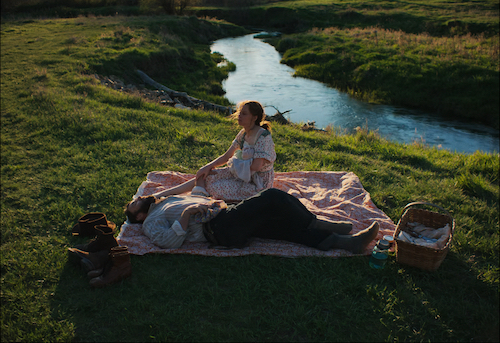
The love story felt almost impressionistic to me, but I guess it all did. The highlights of 80 years of life crammed into 102 minutes. We see why Gladys stands out, that they enjoy each other’s company, enjoy planning their future together, some of which comes true. They mark out the floor plan of their home with rocks, try out walking around in it, later make it a reality. Their own little paradise. It’s all filmed in Washington State and it’s beautiful. Then one day (SPOILER) he gets back in town just as it’s being evacuated due to a wildfire, he finds the cabin burnt to the ground and his family is just gone. Never (definitively) seen again except in memories and hallucinations. He hangs around on his charred acre for a while, hoping they’ll show up, hearing their voices in the distance. It feels very unusual and powerful to me to have this character – played by an Oscar nominated actress even – just die off screen and disappear. He wasn’t around, so neither were we. He gets no closure, so neither do we.
Same goes for an early trauma, the source of the title. He worked on that railroad crew “alongside men who came from faraway lands he’d never even heard of, places like Shanghai and Chattanooga.” One day in 1917 he and a Chinese co-worker (Alfred Hsing, stunt coordinator of IP MAN 3) are sawing wood together when some white men come over and grab the guy, drag him away. Robert knows this is crazy, but doesn’t realize how crazy until it’s too late. He figures they’re accusing him of something (too much faith in justice). “What’d he… what’d he do?”
They just toss him off the bridge. “Grainier was baffled by the casualness of the violence,” the narrator says in another scene, about other anti-Chinese incidents he witnessed as a child. He wasn’t part of this (depending on how you interpret the part where he tries to grab his legs), but he failed to stop it and he never, ever gets over that. He changes jobs but for the rest of his life he has nightmares about trains, and remembers the man’s face, imagines him sitting with him, staring him down.
So this is not an idealized portrait of the good ol’ days or whatever. There’s racist violence, there’s the tragedy of spending your life making money for a company instead of being with the people you love, there’s the very fact of cutting down so many trees, which Arn poetically describes as an act of aggression demanding karmic retribution. “We just cut down trees that have been here for 500 years. It upsets a man’s soul whether you recognize it or not.”
But also there’s the beauty of nature and quiet and solitude and human relationships. He’s mostly a hermit, but when he becomes a carriage driver he meets some people. He gets some dogs. A store owner (Nathaniel Arcand, GINGER SNAPS BACK: THE BEGINNING, SINNERS) who he’s known for a long time checks up on him when he’s depressed. He meets a nice lady from the United States Forest Service (Kerry Condon, UNLEASHED) who’s also widowed. Some things are good around here sometimes, thankfully.
 Edgerton ranks high among my favorite working actors, and I really think he’s undervalued. I mean, did you see him in LOVING? He’s incredible. Still no Oscar nominations, though. (Not that anyone nominated this year wasn’t worthy. It was a tough year.) He reminds me of Tom Hardy a little in the way he likes to dig into an accent and into mumbling, but he doesn’t tend to go mega like Hardy can. He’s so good at these interior, inarticulate characters with a whole lot brewing inside. Rugged but sensitive. Simple but complicated. That’s what TRAIN DREAMS is too.
Writer/director Cliff Bentley previously did JOCKEY (2021) starring Clifton Collins Jr., who has a cameo at the beginning of this. Bentley and his writing partner Greg Kwedar also wrote TRANSPECOS and SING SING, both directed by Kwedar.


























January 26th, 2026 at 7:29 am
Good review, the only trouble is when I’ll be in the mood AND have time for something like this. I like movies like this its just that you have to be in a mood.
My MIL worked with Edgerton on the Dark Matter TV show and says he’s a really standup guy, which is always nice to hear about artists you respect.