
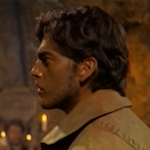
Like I said in my review of HAMNET yesterday, I struggle with understanding the Shakespeare works. That movie was historical fiction depicting the play Hamlet as Shakespeare’s weird way of processing the death of his son Hamnet. Although I kinda liked the movie I felt like I didn’t have the background to properly appreciate it, so I am correcting that by watching JOHNNY HAMLET, a 1968 spaghetti western version of the Hamlet story directed by Enzo G. Castellari (THE INGLORIOUS BASTARDS) and written by Sergio Corbucci (DJANGO).
We’ve already established that I’m no expert on the subject, but this was way more upfront about being Hamlet than I expected. The Italian title wasn’t even Hamlet related, it was Quella sporca storia nel West (That Dirty Story in the West), but the movie opens with Johnny Hamilton (Andrea Giordana, THE DIRTY OUTLAWS) stained with blood, standing in an eerily foggy cave, slowly approaching a mysterious caped figure, calling him “father.”
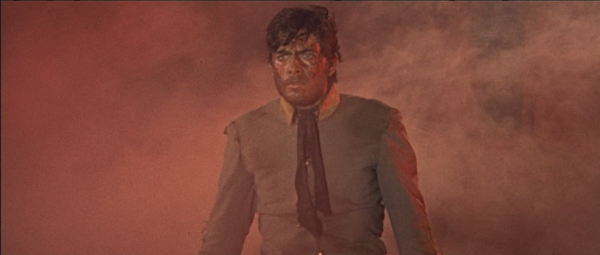
He wakes up on a beach hearing the “to be or not to be” speech, because a fancy lad actor is waving his arms around, apparently practicing to perform the actual play written by William Shakespeare, father of Hamnet. Also there’s a guy dressed like a mime who starts doing handsprings, because Johnny is sleeping under the wagon of a troupe of traveling performers. He’s back from fighting the civil war, and his side lost so… I’m not a fan of his work, personally. Except when he shoots up a hill and kills some bandits coming to rob the troupe. No one else even saw them approaching.
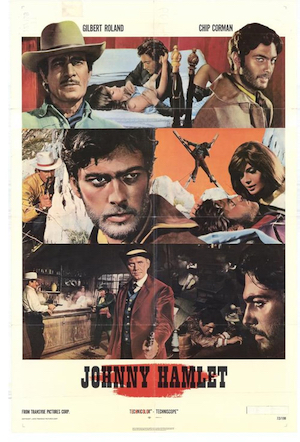 Johnny travels to a cemetery inside a huge cave, lit by candles. He sees a grave marker with his father’s name on it, and the phrase “willfully murdered,” confirming his dream. Some gunfighters named Guild and Ross (do you get it?) try to jump him but he gets rescued by his buddy Horaz (Gilbert Roland, CABO BLANCO), who repeats but does not confirm rumors that a bandit named Santana killed Johnny’s father and was subsequently avenged and “butchered like a dog” by his uncle Claude (Horst Frank, THE CAT O’ NINE TAILS).
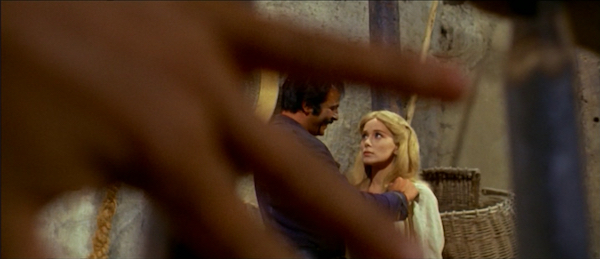
Johnny goes home to Ranch Elseñor (I like that one), where he sees Uncle Claude getting frisky with his mother, Gerty (Françoise Prévost, SPIRITS OF THE DEAD). They’re married now, and Johnny’s not too comfortable with that. He runs into his old girlfriend Emily (Gabriella Boccardo, SECRETS OF A NURSE), whose father (Giorgio Sammartino, THE MOMENT TO KILL) is now the sheriff. Johnny immediately gets in a fist fight with the sheriff, but he loses and then watches through his fingers as the sheriff rips his own daughter’s dress off. ACAB.
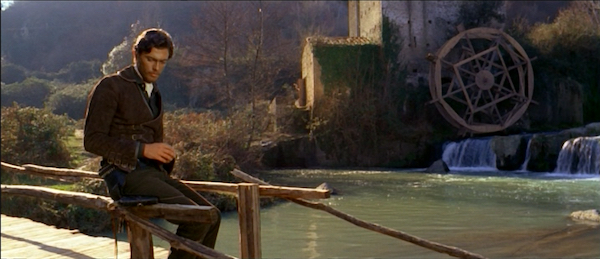
Luckily Horaz shows up to help again and it becomes a surprisingly nimble brawl with lots of flipping, leaping and somersaulting, and moving from inside to outside. I like how this section of the movie is in a very different setting than what we associate with spaghetti westerns, or westerns in general. There’s water, waterfalls, trees and green grass.
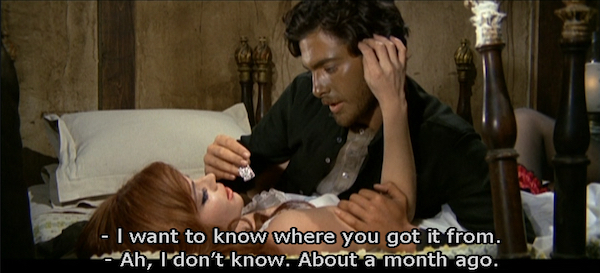
Horaz gives Johnny a small carved object that he says was found next to his dad’s corpse. The movie threatens to get really boring when it’s Johnny following a trail of clues about who killed his father and stole $30,000 of gold, maybe because we know the answer the whole time and he kinda acts like he knows it too. I do like when the performers show up at the same inn so we get to see the mime guy doing flips again and Johnny gets to make it with the beautiful redhead actress (Stefania Careddu, ANY GUN CAN PLAY). He acts like it’s just because her earrings match the object found with the body, but come on – he could’ve asked about that beforehand. He knew what he was doing.
There’s a pretty high amount of fights for a western, energetic ones, including a cool move where Johnny is sitting on his horse, kicks a guy and rolls backwards off the horse. But it truly is a tragedy, because both of Johnny’s girlfriends get killed. And his mom too? I forget – these Shakespeare plays never stick in my brain.
Obviously it doesn’t follow the play to a T, and it doesn’t keep the language other than what’s recited in the beach scene. But it’s a smart adaptation in that
1) the changed setting and genre fit the story surprisingly well and
2) it takes advantage of the power of cinema to do things that can’t be done on stage. Yeah maybe you could fire guns, but you couldn’t make the audience see from the many gimmicky angles found by director of photography Angelo Filippini (DJANGO THE LAST KILLER), who loves filming the action through things: the flames of a fireplace, a long cannon barrel, a wagon wheel, a pair of crossed boots…
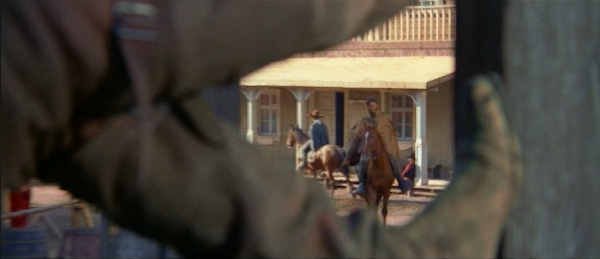
a bullet hole in a sheriff’s badge…
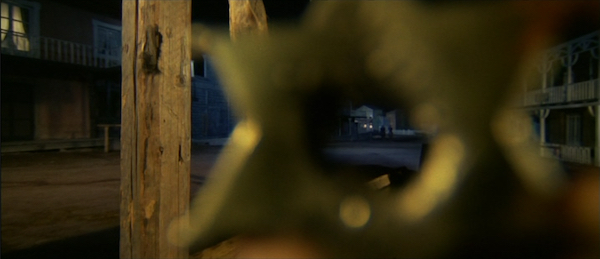
(which reminded me of the shot in EVEN COWGIRLS GET THE BLUES that was framed through a bite in a cheese sandwich)
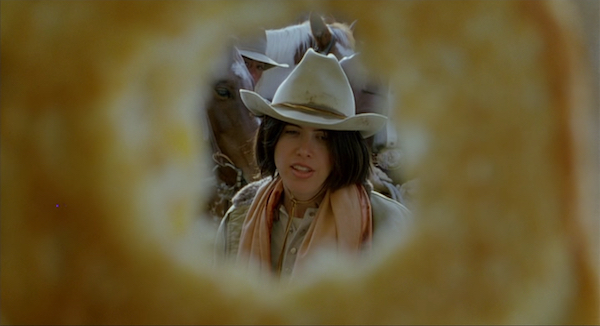
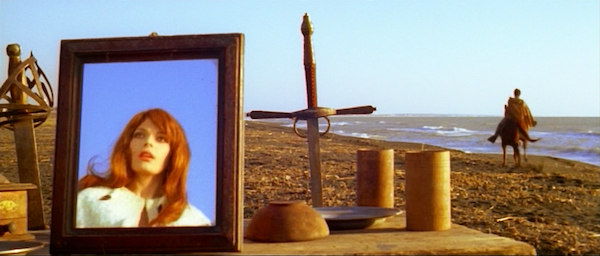
and probly some other ones I forgot about. I’m not saying it’s one of the most stylish spaghetti westerns, but it’s definitely making an effort. Check out this nice little still life type composition, and its use of a mirror:
But my favorite might be this one, which rotates around Johnny so he appears to be hanging sideways the whole time:
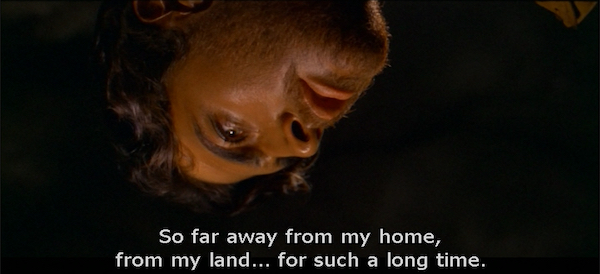
To see that on the stage you’d have to turn the actor giant and suspend him from cables. Or spin the entire room. It would be cost prohibitive.
Also, I gotta say, the cemetery is really impressive! I imagine most stage productions can’t manage that kind of scope. As far as deepening my understanding of HAMNET, seeing this retelling reminded me of the scenes involving the gravediggers (in this version just one, played by Franco Latini, MAY GOD FORGIVE YOU… BUT I WON’T) digging up different graves. I hadn’t thought about that fitting the premise that Shakespeare could’ve written the play while dwelling on a death in his family.
I don’t know if Agnes Shakespeare would’ve been moved by this movie the way she was by the play, but I bet her and her bird would’ve been impressed just by the technology (movies did not exist in her time if I’m not mistaken). Much like HAMNET, I did not full-on love JOHNNY HAMLET, but I can respect that it definitely has its moments. I’m getting there.


























January 8th, 2026 at 12:03 pm
Cool find. This reminded me that in high school, we had an assignment to adapt a Shakespeare scene to a different setting, and I chose to do the end of MacBeth as a western. I changed all the dialogue to be over-the-top Western cornpone. I still think that kind of adaptation could work, almost like an inverse of HIGH NOON, where the sheriff and his wife are the problem.
Anyway, I did not intend to rip off Corbucci and Castellari, but I’m glad to learn this movie exists.