
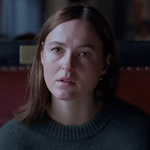
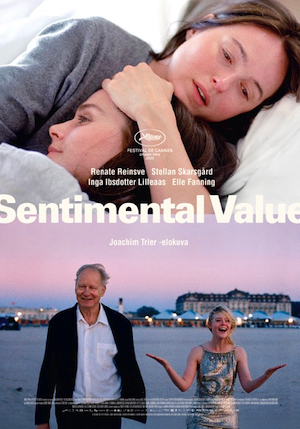
 SENTIMENTAL VALUE (Affeksjonsverdi) is the beginning of my awards season viewing ritual of seeing movies that I know almost nothing about except they’re supposedly good. It’s on all the lists of predicted best picture nominees, but also my friend Matt Lynch told me to see it, so I was planning to.
It’s from the Norwegian director Joachim Trier, who has been directing features for almost 20 years but the only one I’ve seen is 2021’s THE WORST PERSON IN THE WORLD, which I enjoyed but did not review. This reunites him with that film’s star Renate Reinsve (who made her debut in his second film, OSLO, 31 AUGUST). It’s one of those director-actor combinations that works so well I assume they’ll make five or ten more.
The story centers around the Oslo home of the Borg family. In the opening scene, a narrator (Bente Børsum) describes it through the perspective of Reinsve’s character Nora, when she had to imagine a building’s feelings for a school assignment. It’s a poetic description of the personality of a house and its meaning to the people who spend their lives in it, multiple generations of the same family living and dying in the same rooms. I thought of Robert Zemeckis’ HERE in this sequence, with its match cuts between time periods, showing the same locations in the dress of entirely different eras.
That history includes alot of heartbreak. For their father Gustav (Stellan Skarsgård, DOMINION: PREQUEL TO THE EXORCIST) it’s the place where his mother hung herself when he was seven. For Nora and her sister Agnes (Inga Ibsdotter Lilleaas, A BEAUTIFUL LIFE) it’s where they lived with their mother after the divorce, when Gustav moved to Sweden and became mostly absent from their lives. So it’s uncomfortable now that they’re having a memorial for their mother at the house and Gustav shows up unexpectedly. He slips in unnoticed, goes and sits by himself in a room that has meaning to him but has been his ex wife’s home for so many years. Nora only realizes he’s there when she hears his voice through a vent.
 Nora is a successful actor, appearing on some TV show but most famous on the stage, headlining crazy modern operas or something. We don’t see much of the actual production, but we see the hectic lead up to her walking out on stage, when she keeps making them adjust her costume, darting off down the labyrinthine halls and nooks around the opera house trying to get herself psyched up. Her bout of stage fright is like a long stress dream for the viewer. I have sympathy for her as she goes through this panic, and also for every person on that crew who’s in absolute terror that they’re not going to be able to get her out there. You could argue that she has some issues, and they all suffer for it.
Younger sister Agnes seems to have made it through childhood a little more intact. She works as a historian, has a husband, Even (Andreas Stoltenberg Granerud) and son, Erik (Øyvind Hesjedal Loven), and she seems forgiving about her dad calling the former the wrong name and being fairly casual about just now meeting the latter for the first time. She talks to him more than Nora does, has even done research for his movies. He’s an acclaimed director, not at the top of his game anymore but they’re about to do a big retrospective of his work at a film festival.
The hook is that Gustav has written a script that would be his first movie in many years, and his most personal, and he tells Nora he wrote it for her to star in, playing a character inspired by his mother. It could be a big break for her and he thinks only she could play it. She protests that he’s never even seen her act; in fact he has, but has never stayed for a whole show. He seems to genuinely think she’s good but be picky about everything else. And he’s very opinionated, obviously. He’s not a theater or TV guy. He knows what she could do with her eyes if a camera was there. She won’t do it, though. Won’t even read it.
Then the famous actress Rachel Kemp (Elle Fanning, MALEFICENT) is moved by one of Gustav’s old films at the retrospective and invites him to dinner with her and her friends. They end up all hanging out on the beach until the sun comes up. They bond over art, he’s fatherly in a way he probly never was with his actual daughters, and SENTIMENTAL VALUE begins to split between Nora’s life and Gustav’s attempt to make the movie without her. He wants to film it in the house, which he still owns.
There’s a subplot about him wanting to bring his old d.p. Peter (Lars Väringer) out of retirement, get the band back together. He goes to visit him and gets him excited before realizing that he has trouble walking now and could never operate a handheld camera like he used to. It made me think about us aging movie lovers in a different way. As a young person I had all these artists who were there for me not just in their existing work, but in the near future – always looking forward to their next one. And some of them are still there. It’s hard to face losing more and more of their work, whatever may cause that. I want Scorsese and Spielberg and Eastwood and Miller and Woo and Cameron and Miyazaki and everybody to somehow keep going, and to keep being great, but I’m asking too much. Sitting at home maybe I think of it in terms of “Do they still have it in them to make a great movie?,” but this asks what if the people they want to work with aren’t around anymore? And what if it’s not any fun without them? Maybe they’d rather just stay home with their families, like John Carpenter. I should thank them for their service. I shouldn’t be greedy. I shouldn’t ask or expect any more of them. Their job is hard!
I think of movies like SENTIMENTAL VALUE and THE WORST PERSON IN THE WORLD as being very humane, because they have characters who are so flawed, but we don’t judge them, we love them anyway. Here we get an idea of the generational trauma connected to some of their bad choices, but I think I’d be forgiving even without that explanation. Nora is such a mess and she sleeps with a colleague she knows is married (Anders Danielsen Lie, PERSONAL SHOPPER), but, I don’t know… I still like her, I still feel bad for her when the guy’s marriage is over but he’s not interested in her anymore, I still think “good one” when she says something really cold and well-deserved to Gustav’s face, even though I also don’t judge him. He’s a terrible father and a good artist and a snob and an interesting person and he’s genuinely trying to do something for his daughter and not even trying to act like it makes up for anything. People are complicated. It’s not an excuse. It doesn’t redeem everybody. But it’s true. Even if easier to appreciate on a screen than in your life.
Gustav Borg is a pretty good version of a fictional filmmaker because his fake movies seem a little more like real movies than most fake movies, without seeming like something I’d rather be watching than the real movie. When we see the ending of the movie that impressed Rachel so much it doesn’t seem to me like a good ending of a movie, but it’s a good scene on its own. Throughout SENTIMENTAL VALUE they talk about what will be the last scene of Gustav’s new movie, and that does not seem like a good ending to a movie either. But the filming of it ends up being a great ending for this movie. Not in the sense of “damn, everything fits together perfectly” but in the sense of “I need to think about what this is saying here” and then the more I do that the more I love the movie.
I could be wrong, but I think Gustav’s declarations about art are mostly things Trier agrees with. They certainly both care deeply about the performances. I’d have to see it again to pay attention to how much their filmmaking approaches overlap. I love when Trier starts a scene in such a way that we’re led to misunderstand what’s going on at first, and then go through a journey as we try to catch up. For example, when Gustav’s return has sent Nora into some emotional turmoil and she steps outside and suddenly breaks down sobbing. As the camera pulls out I realize oh, this is later, and she’s on the stage at rehearsal, surrounded by the rest of the cast watching her. This isn’t real, it’s an exercise. Except then I think well, surely what she’s going through is feeding her performance, her ability to cry. In a way maybe this is real, this is her reacting to and dealing with what’s going on in her life, just not in the way I initially assumed.
I also love when Trier gets excited about procedure, and decides to give us a whole montage about pulling files from an archive, or remodeling a house. Most of the movie is so intimately wedged into the lives of these people and their relationships, but every once in a while it pulls back to show a history or a system or some other piece of a larger world they’re a part of. You know, it’s about these three members of this family in the present and the ways they hurt and help each other, but also it’s about their whole lives and suicide and being a child actor and WWII and other things.
This is a great movie, with a respect for the creation of art as therapy, and as communication, with a love of people and life, a recognition that things can be terribly sad and also pretty funny and also sometimes things can get better. I’m glad I heard it was supposed to be good. It is.





























December 29th, 2025 at 10:43 am
Great movie. I can’t believe he gave the kid Irreversible on DVD as a gift lmao