
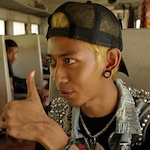
 Yesterday I reviewed STREET PUNX, which I did not think was a successful movie but I was intrigued by its movie-within-a-movie topic of punk rockers in Yangon, Myanmar, and the lead character mentioning that there is a documentary about them. Last night I rented that documentary on Vimeo and yes, it was very much worth sitting through STREET PUNX just for that movie recommendation.
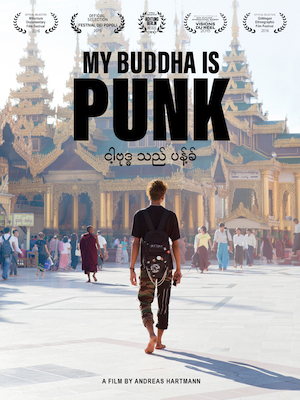
MY BUDDHA IS PUNK (2015) is a 67 minute cinema verite look at Kyaw Kyaw, the lead singer of a band called Rebel Riot. He was in STREET PUNX mostly talking to the main character on video chat. There he came across as a goofy, sweet, kind of shy guy with a whole bunch of girlfriends, and it came as a surprise when the movie ended on his moving explanation of the importance of artists in a revolution. Here, though, the younger Kyaw Kyaw is absolutely magnetic, a wise punk rock guru always speaking philosophy and inspiration, always teaching and advising. He straight up doesn’t believe in leaders, but seems to be the driving force of a punk rock movement and subculture in Yangon. He has a bunch of friends and band members who live and work together as a collective, but at least when the cameras are on most of them don’t talk much. They’re always listening to him. He genuinely seems a little frustrated by this. He’s always soliciting responses, but usually not getting them
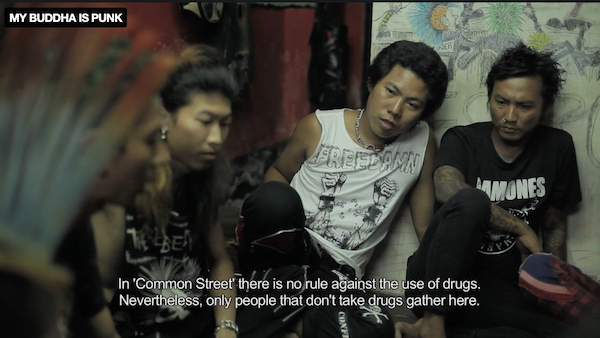
An early scene that shows us how interesting he is is when the punks have a meeting. They need to address that one of them confessed to stealing their collective money. Kyaw Kyaw keeps inviting other people, including the guilty party, to express their feelings about it. One wants to know if he used the money for drugs. Kyaw Kyaw explains that using drugs is incompatible with their “path” but his stance is that you won’t be judged for it you just need to be honest and move on to your different path.
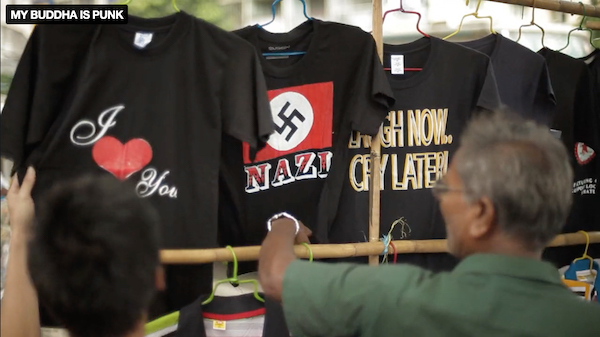
I’m watching this with almost zero context of Myanmar’s larger culture, let alone punk’s place within it, and this is not the type of documentary that does any explaining beyond a little bit of text at the beginning. But that’s my preferred form of documentary: the kind that just drops you in to try to figure out what you can about what you’re witnessing. I had a little trepidation because they use the words “skinhead” and “oi,” which can have white power/far right connotations in the west, and then one of them is reading a book with a big photo of Hitler on it. I knew there were different ways to interpret this but sure enough there is a fascination with Nazi imagery for some people in Myanmar at this time – one scene shows a non-punk guy in a street market trying to decide between two different swastika t-shirts and one that just says “I ♥ YOU.” I can only guess what that’s about.
Thankfully the movie eases our minds with a close up of Kyaw Kyaw’s t-shirt for the Pittsburgh band Aus-Rotten, which says “AUS-ROTTEN – AGAINST NAZIS – FUCK NAZI SYMPATHY.” Later he’s lecturing some kids about thinking “Nazi” is a cool word and using it in their band name. I’m unclear whether this is a hypothetical or something the kids actually did, but he explains what the Nazis did and points out that if they’re against their own country’s dictatorship they should also hate that dictatorship.
The most tension ever in the movie is while they’re working on a zine that he says is “the first punk magazine in Myanmar.” He’s gently encouraging everyone to find a way to be a part of it, whether it’s cartooning or whatever, and one of them jokes that Kyaw Kyaw is their “godfather.” Kyaw Kyaw doesn’t exactly lose his cool but he gets very offended, saying that he doesn’t understand punk if he thinks there’s a godfather, that nobody here is beneath anybody, they’re all on the same level. The other guy is very drunk, mostly good natured, but questioning Kyaw Kyaw more than usual. Kyaw Kyaw talks calmly but pretty much tells him he’s wasting his life and passion. When he says “You only have your fashion left. You don’t truly live Punk through your actions anymore,” that’s the least kind we ever see Kyaw Kyaw, but it still seems to come out of caring.
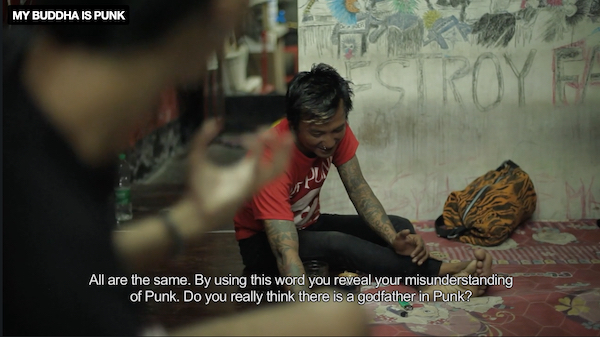
During that whole semi-argument he’s trying to write an article about Putin imprisoning Pussy Riot. He reads what he has out loud, and one of his bandmates suggests a point he’d like to add about society not thinking punks are serious-minded people. Kyaw Kyaw stews on it for a while and then reads his reworking with the suggestion as the ending, and he raves about this addition making the whole thing work much better. He truly seems invested in everyone collaborating.
What’s most clear is that he’s very serious about his code of punk. You know I love movies about people who are very serious about their codes, but usually that’s a samurai movie or something where they’ve been indoctrinated with the code and part of the thrill comes from when they start to see its limitations and grow beyond it. This is different because it’s really something where he took inspiration from others and crafted the parts he liked into a very positive philosophy of egalitarianism and freedom. Their fashion is rebelling against the society around them but it’s not just opposition and chaos – the first big scene is a huge amount of punks participating in a large peace rally where everyone releases silver balloons and rings bells.
Maybe that would be corny to some American anarchy punks, as would their optimistic praise of a politician (opposition leader Aung San Suu Kyi, who was part of trying to transition from a military junta to a democracy, though a coup would soon make things worse). This was shot in 2012, and there’s much excitement in Yangon about a visit from Barack Obama. The punks see his motorcade, and they’re definitely interested, though not in the same worshipful way as some of the people around them. Like some of us here, Obama seems to have represented “HOPE” to them, to work with Aung San Suu Kyi for a better tomorrow.
 The oppressive military is only one of the problems in Myanmar. There’s also been violence between Buddhists and the Muslim minority. One of the punks buys into it, saying the Muslims are a threat to Buddhism, which Kyaw Kyaw patiently asks him questions about, trying to get him to realize how stupid he’s being without coming out and saying it.
Religion is an interesting part of this. They record a song called “Fuck Religious Rules & Wars,” and the title MY BUDDHA IS PUNK makes it sound like Kyaw Kyaw is an atheist, but he seems to be a Buddhist. We follow him to meditate at a shrine, and he sometimes mentions Buddha and Buddhist ideas in his philosophizing. He just hates organized religion and the perverting of Buddhism into an excuse for violence. Of course there are Christian equivalents to this, but I don’t know, it seems cooler when it’s Buddhism! I guess because I grew up with Christianity and it didn’t take.
Kyaw Kyaw keeps referring to something called “Common Street,” which I think is what they call their movement. They set up a booth at the market with a banner that says “CS Youth Council,” basically doing outreach for their punk lifestyle, talking to people, selling their zine, also taking orders for spiked jackets that they can make in different styles or customize if you have an idea for it. They take measurements like you’re buying a suit! I was excited about this part because I noticed all the elaborate jackets in their scenes in STREET PUNX but it never would’ve occurred to me many of them were made by the same people as a way to grow the movement.
They’re such evangelists that the Rebel Riot take a train ride to another city to meet up with what Kyaw Kyaw describes as “school boys.” It’s sort of a recruiting mission where they give them jackets, spike their hair for them, tell them they should have their mom read the zine to understand them, and sit around talking about what punk means to them. It’s a funny scene because the kids look shell shocked, they knew they wanted to look cool and have a band but they seem overwhelmed by all this explanation of what it means.
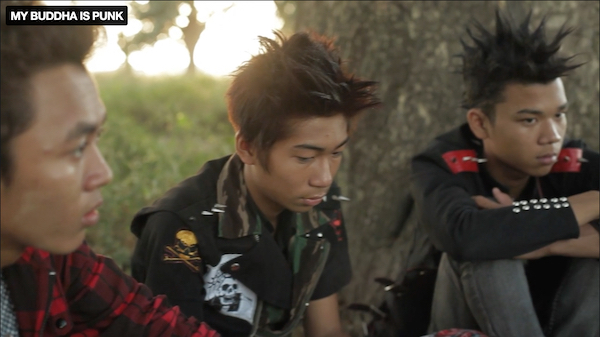
I definitely get a sense of “what did we sign up for?” but also I ended up feeling like maybe one or two of them will really get into this. At any rate the o.g.s emphasize that they’re not telling them rules to follow. “This is just advice amongst brothers. It is insight from us to the younger generation. In Punk there is no order. We just show you the path you can take. Simply put, Punk is the way of life that you choose for yourself. That’s it.”
This is a great movie, a look at a fascinating person, maybe made more interesting by the fact that there’s no background at all on the guy, no explanation of how he came to these ideas and this central role in a movement. But I loved seeing his drive to spread the good word of this way of living. And he’s so charismatic he can tell a kid on a train not to become a soldier or a cop because they’re bad people, and even all the elders hearing this seem entranced by him. I realize humans are flawed, there’s a high probability that someone could tell me about some blindspot or falsehood in this depiction of an idealistic, positive force. I did not notice any women in this movement at all, I should note. But even if it wasn’t right now, with what’s going on in our country, it would be so inspiring to see these guys trying to do this, lashing out artistically against an oppressive government, purposely standing out in a rigid society, trying to live by a set of values that aren’t always the easiest path.
Director Andreas Hartmann is German but all of his movies are documentaries shot in Asia. The last two were set in Japan and both sound really interesting and thematically linked – A FREE MAN (2017) is about a man who chooses to be homeless and JOHATSU: INTO THIN AIR (2024) is about people who decided to start their lives over under new identities.
Thank you STREET PUNX for telling me about MY BUDDHA IS PUNK. It’s unfortunately not on physical media, but I’m glad I was able to see it without using Amazon. Just like I never used a sword but love stories about samurai, this is not a type of music or a fashion that I’ve ever been a part of, but it represents something I relate to profoundly. Oi oi oi (as in hey hey hey, not the skinhead thing).
























January 1st, 2026 at 5:04 am
Happy New Year to you! Keep the amazing reviews coming. Can’t wait to see which Clint classic we get first this year. Thanks for making a shitty dumpster fire of a year a bit more bearable.